100 Questions and 3,000 Answers


President Reagan was quoted as saying that if the game Trivial Pursuit were designed by economists, the game would have 100 questions and 3,000 answers. President Reagan’s quip is the title of a Tidbits feature called “100 Questions and 3,000 Answers.” This feature highlights a question or comment from a reader along with a response. Send questions or comments to rollingeconjay@gmail.com.
Question/Comment:
The Tidbits article on trade with Canada (9/21/2026) made me wonder how Nebraska ranks compared to other states selling agriculture products to Mexico and Canada. Is Nebraska more reliant on trade with these two countries compared to other states?
Response:
Trade with Canada and Mexico are important to Nebraska. Mexico is typically the state’s top export market for agricultural goods while Canada is the second-largest. Farm machinery, ethanol, and meat products make up the bulk of the exports to Canada. Corn, meat products, and soybeans are the largest exports to Mexico. The North American countries have grown in importance in recent decades due to the NAFTA and USMCA free trade agreements. However, Nebraska’s reliance on trade with the two countries had diminished in recent years compared to other leading agriculture exporting states.
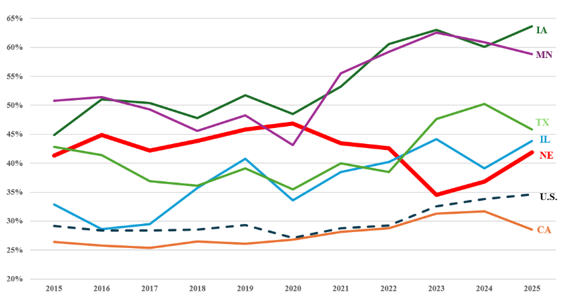
Figure 3 plots the shares of total exports to Canada and Mexico for the top agricultural exporting states and the U.S. between 2015 and 2025. Agricultural exports include bulk commodities, processed goods, byproducts, farm machinery, ethanol, and other agricultural goods. In 2025, 42% of Nebraska’s total agricultural exports were shipped to Canada and Mexico. The state’s share sits above California and the U.S. overall but is below the other leading agricultural exporting states. Earlier in the period, Nebraska’s share exceeded 45%, but things changed after 2020 and its share relative to other states started to decline. In contrast, the share of exports to Canada and Mexico from Iowa, Minnesota, Illinois, and Texas grew. Iowa and Minnesota, in particular, saw growth in exports to Canada in recent years which could be connected to that country’s growing imports of ethanol. Nebraska’s notable decline in 2023 could be the result of the drought in 2022 and lower corn and soybean production, meaning fewer bushels were available for export. Nebraska’s growing processing and livestock sectors might also be contributing to Nebraska’s less reliance on trade with these countries.
So, the state’s reliance on exports to Canada and Mexico relative to other agricultural exporting states has been higher in the past but has shrunk in recent years. Still, exports to these countries are important, comprising more than 40% of total agricultural exports in most years. Nebraska farmers and ranchers have a strong stake in the outcome of the USMCA discussions as well as the dispute with Canada.
Figure 3. Share of States’ Total Ag Exports to Canada/Mexico