

A Bridge Over Troubled Waters


Nebraska crop producers have received more than $632 million in Farmer Bridge Assistance (FBA) payments this year as of April 22. Roughly $9.6 billion in payments have been disbursed nationwide, with nearly 500,000 applications received. FBA payments are based on a flat, per-acre payment for all acres planted to eligible commodities in 2025. The FBA program, announced last December by USDA, is intended to provide $12 billion in one-time payments to producers of covered commodities as an economic bridge until farm program payments are made later this year. The farm program changes made in last year’s One Big Beautiful Bill Act went into effect for the 2025 crop year and payments will be disbursed in October.
Figure 4. Farmer Bridge Assistance Payments by State (Millions $)

Figure 5. Farmer Bridge Assistance by Nebraska County
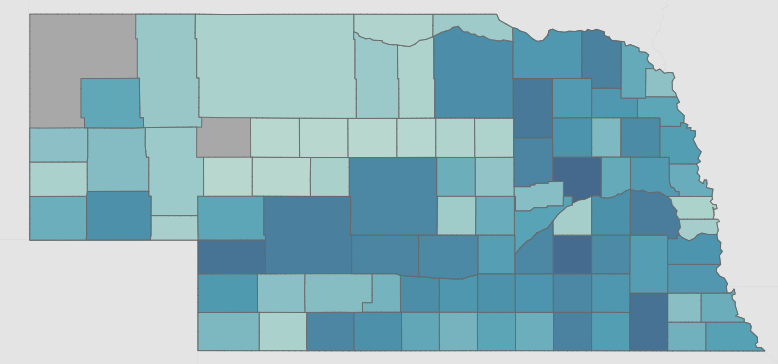
Figure 5 shows payment totals by county in Nebraska. Darker-colored counties received greater payments. Platte and York Counties have seen the largest payments thus far with $16.0 and $15.7 million, respectively. Gage and Polk Counties follow with $14.6 million in payments each. Nearly 33,000 Nebraska producers applied for payments.
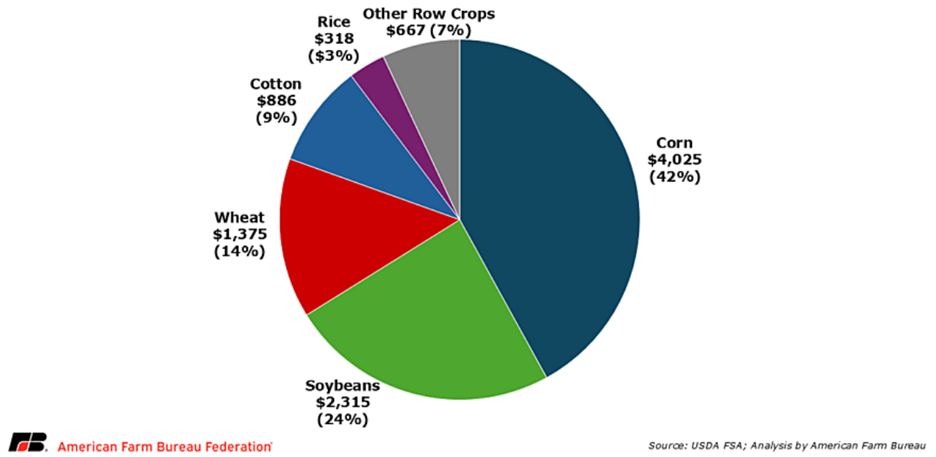
The American Farm Bureau Federation says corn and soybean acres have received the bulk of payments nationwide, with corn payments accounting for $3.45 billion and soybeans $2.27 billion. Payments of $1.34 billion have been made on wheat acres. According to the Farm Service Agency, payments on corn acres accounted for the bulk of payments in Nebraska, $446.4 million of the total. Payments on soybean acres are $139.6 million and wheat payments equal $31.4 million. Surprisingly, payments of $7,500 on base acres in peanuts have been made in Antelope County, while acres with cotton base have received payments of roughly $2,300 elsewhere in the state.
Figure 6. Farmer Bridge Assistance Payments by Commodity
It is well known that crop producers are facing troubled waters in 2026 with stubbornly low commodity prices and high input costs. The recent surge in fertilizer and fuel costs and drought have only added to the challenges. Almost 63% of bankers surveyed in the most recent Creighton University Rural Mainstreet Poll said the FBA payments have had little or no impact on their local economies. Still, the payments should help farmers bridge the gap until farm program payments are disbursed this fall.