

Agricultural Imports Outpace Exports in 2025


U.S. imports of agricultural goods outpaced exports by almost $41 billion in 2025. Exports, at $171 billion, were off 3%, while imports were steady at $212 billion. Last year marked the fourth consecutive year the U.S. had a deficit in agricultural trade, an occurrence which historically has been rare.
Trade deficits, though, are neither inherently good nor bad. It is simply an accounting of the flow of goods between countries. U.S. trade in agriculture with other nations is largely complimentary. The U.S. exports beef, corn, and soybeans to the rest of the world while importing consumer-oriented goods like coffee, wine and liquor, vegetables, and fruits. Imports of fruits and vegetables have grown considerably in recent years, pacing the growth in total imports. Market observers attribute the growth in fruit and vegetable imports, at least in part, to labor shortages in the U.S. Growers are unable to secure labor in the U.S. and as a result move operations out of the country.
Corn, wheat, and ethanol exports all increased last year, with corn leading the gains at a 33% rise (Figure 2). Red meats (beef, pork, and lamb), hides, soybeans, and animal feed saw declines in value. Soybeans were off 33% and hides were down 19%. Within the red meats, beef export value was off 11% and pork down 3% according to the U.S. Meat Export Federation.
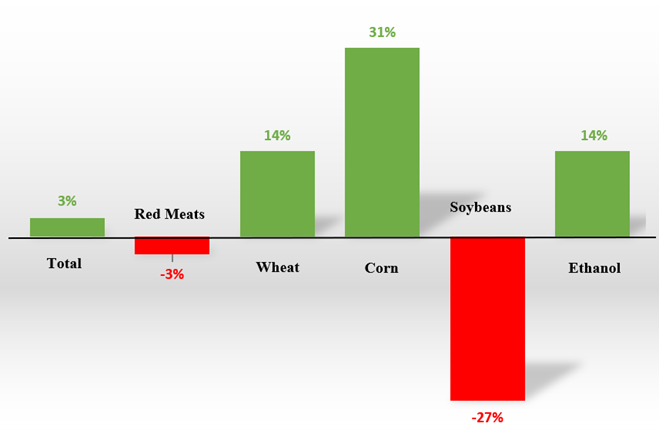
In contrast, the volume of U.S. agricultural exports was up 3% in 2025, following a 21% surge in 2024 (Figure 3). Again, corn exports led the way, rising 31%. Wheat and ethanol exports were up 14%. Red meat tonnage was down 3% and soybean shipments were down 27%. Lower meat production meant less product available for export last year, while the lack of Chinese purchases until late in the year hurt soybean exports.
Figure 2. Changes in the Value of U.S. Agricultural Exports, 2025 vs. 2024
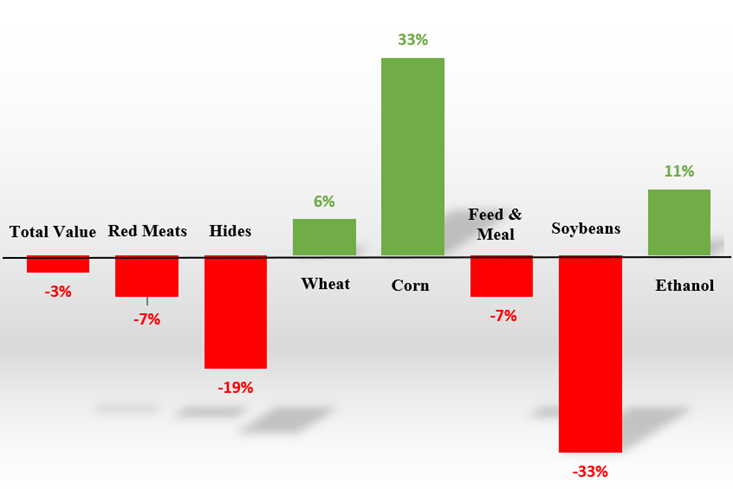
Figure 3. Changes in the Volume of U.S. Agricultural Exports, 2025 vs. 2024
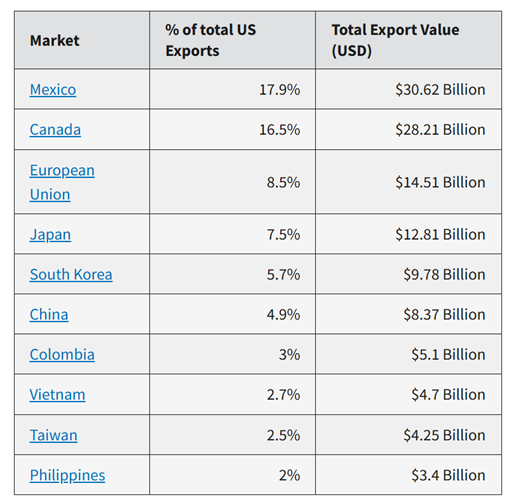
Mexico led all countries in purchases of U.S. goods, importing almost $31 billion, or 18% of total U.S. agricultural exports. Mexico is a large market for U.S. corn and beef, key exports for Nebraska. Canada and the European Union followed with imports of $28 billion and $15 billion, respectively. The effects of free trade agreements can be seen in the top markets for U.S. agricultural goods. Several leading importers (Mexico, Canada, Japan, South Korea, Columbia, Vietnam, and Taiwan) have agreements with the U.S., and agriculture is a significant beneficiary of the agreements.
Table 1. U.S. Agricultural Export Markets, 2025
The USDA trade outlook released in February projected agricultural exports and imports would be lower for the government’s fiscal year, which ends September 30. Cattle imports are forecast to be lower with the closure of the Mexican border, contributing to the lower imports overall. Corn, pork, and ethanol exports are forecast to be higher. Beef, wheat, and soybeans exports are forecast to be lower. These projections were made prior to the war in the Middle East. Forecasts released in May should shed light on the impacts of the conflict to U.S. agricultural trade.