

AI Advances in Agriculture


Artificial intelligence’s (AI) promises, pitfalls, infrastructure needs, and potential influence on society are prominent topics for the media, elected officials, and the general public. The technology promises to impact and change all sectors of the economy. Agriculture is no exception. But because agriculture encompasses biological processes involving weather, pests, and disease, complicated by volatile markets and government policies, it poses unique challenges for AI. Yet, its adoption in agriculture moves forward. Alex Thomasson, director of Mississippi State University’s Agriculture Autonomy Institute, wrote, “AI is transforming the entire agricultural value chain. Applications extend beyond crop production to include livestock management, food processing, supply chains, natural resource stewardship, and scientific research.”
McKinsey & Company’s Global Farmer Insights survey earlier this year touched on the adoption of technologies by the world’s farmers, particularly AI. In all, 5,500 farmers were surveyed, operating farms ranging in size from fewer than 120 acres to more than 6,500. Row crop farmers represented the largest segment surveyed followed by specialty crop farmers. Livestock farmers were not included.
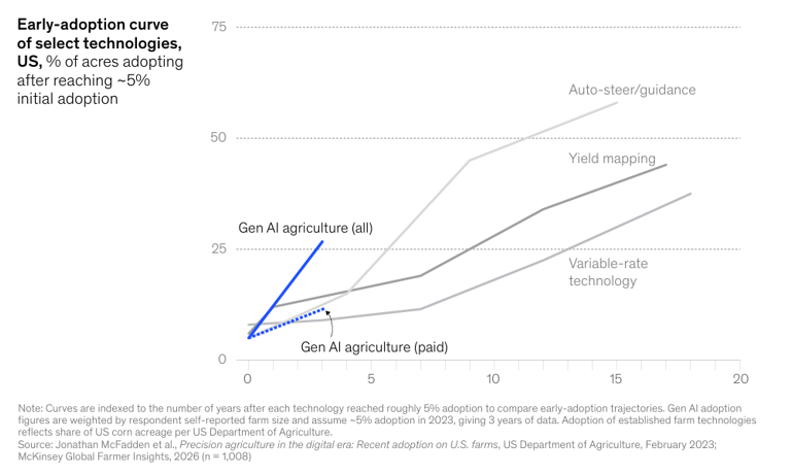
Farmers’ responses indicated they are rapidly moving forward with the adoption of technology. In the U.S., nearly 80% of farmers said they had adopted some form of guidance system, irrigation control, precision tool, or other technology, by far the highest rate in the world. The adoption of AI appears to be moving rapidly, too. Figure 2 compares the rate of adoption of generative AI by U.S. farmers with that of earlier technologies like auto-steer, yield mapping, and variable-rate technology. Generative AI refers to systems that can learn patterns from training data and create new content like text, images, code, or video in response to user prompts. Interestingly, U.S. farmers’ adoption of generative AI is running ahead of previously adopted technologies. McKinsey & Company said that, since 2023, farmers’ use of generative AI has grown to cover 25% of farmed acres in the country.
Figure 2. U.S. Farmers Adoption of Generative AI
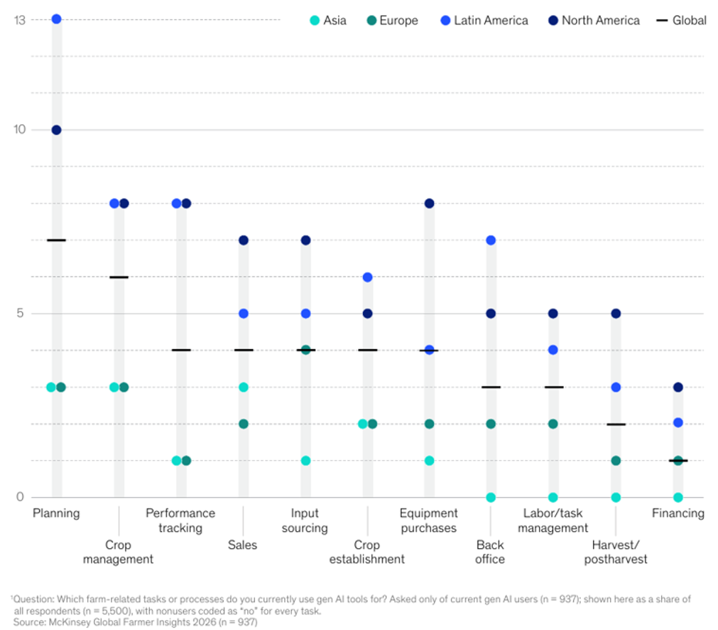
Farmers’ top uses of AI globally are for planning (43% of respondents) and crop management (33%) (Figure 3). AI’s usefulness in performance tracking, equipment and input purchases, and sales was also noted, particularly by farmers in North America. Farmers, though, are skittish about the use of AI for agronomic decisions. McKinsey & Company said, “Farmers expressed skepticism in interviews about AI’s ability to provide informed agronomic recommendations specific to their local growing conditions.” But they also “Acknowledged its usefulness for information gathering, comparing products, troubleshooting, and refining questions.”
Figure 3. Adoption of AI Tools by Task, 2026 (% of respondents)
AI technologies will fundamentally change how crop and livestock farms are managed. On crop farms, Thomasson wrote that AI technologies will, “change the fundamental unit of management from the field or zones to the square meter or even individual plant.” For livestock production, he said, “AI enables continuous monitoring through computer vision, wearable sensors, automated feeding systems, and acoustic monitoring.” AI will help agriculture address complex challenges like water quality, labor shortages, and increasing production with fewer inputs and with less environmental impact. Nebraska, with its strong crop and livestock sectors, innovative producers, and the recently announced Digital Ag Hub at the University of Nebraska and its research in precision technologies is well positioned to lead the way.