

AI Agentic Agriculture


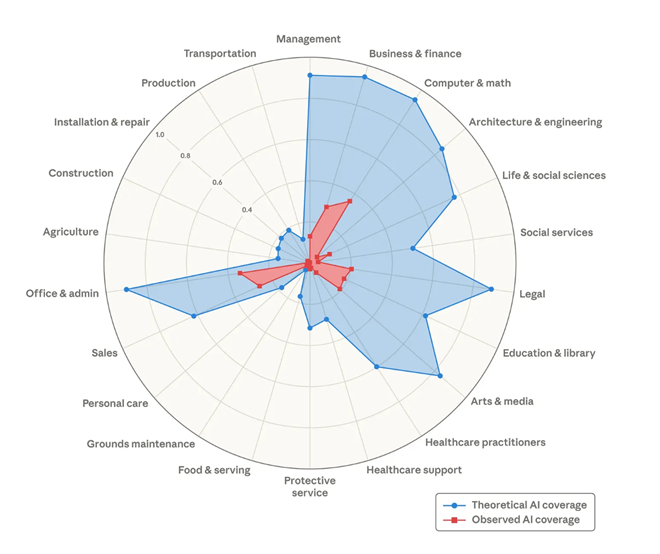
Artificial intelligence (AI) is becoming ubiquitous. Every day brings news of its different applications, projections on its effects on jobs, or controversies over its use by the military. However, relative to other economic sectors, agriculture is lagging in AI adoption. Figure 2, created by Anthropic, the developer of the Claude series of large language models, shows the theoretical share of job tasks AI could perform in different occupational categories (blue area), and the current observed AI usage in those categories (pink area). While the theoretical AI share in agriculture is low compared to other sectors, its current adoption is also next to nil.
Figure 2. Theoretical Capability and Observed Usage by Occupational Category
But that is changing. AI’s usage in agriculture is rising according to Kevin Van Trump, founder and CEO of Farm Direction. Van Trump attributes the growth to the creation of “AI agents.” AI agents are “autonomous digital workers that think, plan, decide, and act on their own.” Agents “break complex goals into steps, adapt to surprises, collaborate with other agents or humans, and loop until the job is done.”
Van Trump cites examples of AI agents already in use in production agriculture. Agents in drones or satellites monitor fields detecting nutrition stress, moisture shortages, and pest outbreaks and suggest prescriptions. Agents in sprayers spot weeds and direct spray at the correct rate. Autonomous weeding robots and tractors use agents for guidance. Wearables on livestock use agents to monitor feed intake and other health metrics. Farmers use agents to “watch basis and futures 24/7, sending clear ‘lock it in’ signals so the digital marketing employee never misses a move.” Production agriculture isn’t the only sector in agriculture experiencing changes through AI. McKinsey & Company, a consulting company, says AI “is now also transforming the post-trade engine room underpinning every commodity book.” Further, “As agentic AI is implemented, and the creation of automatic digital employees accelerates, players could decrease data to trade time, limit errors and increase trade life cycle efficiency.”
No doubt the adoption rate of AI in agriculture will grow. Van Trump says farmers already using AI are seeing cost savings of 25–45% and revenue increases of 15-30%. McKinsey says commodity traders adopting AI can reduce costs by 60% in the next 5-10 year. But AI adoption also comes with the costs of adopting new technologies, new ways of approaching management, and learning curves. Not adopting means becoming less competitive in a highly competitive market. Not an easy decision for farmers in today’s challenging financial environment.