

Are Aging Producers a Concern


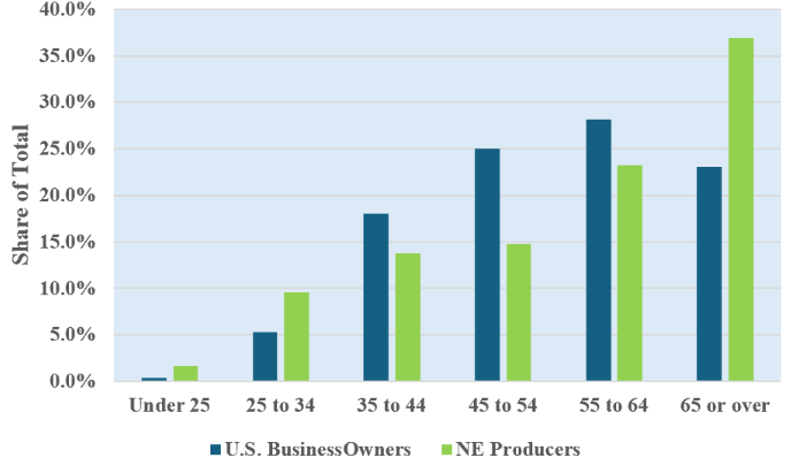
The aging of producers has been an ongoing trend for years. The average age of Nebraska farmers between 2012 and 2022 rose from 54.3 to 56.9 years. The culprit is the growing number of producers aged 65 and older. In 2022, producers aged 65 and older accounted for 37% of all producers. Ten years earlier, they comprised just 23%. Compared to other business owners, the average age of Nebraska producers is higher. The average age of Nebraska business owners is thought to be slightly higher than the U.S. average of 50.1 years. The share of business owners aged 65 or older is 23.2%, markedly lower than the share for farmers. However, when looking at owners aged 55 years or older, the shares are largely the same. About 50% of Nebraska business owners are 55 years or older; 51% of farmers fall into this cohort.
Figure 3 shows the proportions of Nebraska farmers and U.S. business owners in six age groupings. A greater percentage of both Nebraska farmers and business owners fall in the older age groupings. But when comparing younger age cohorts, farmers represent a greater share relative to other business owners. Why? Perhaps because 97% of farms are family-owned, younger producers join their family operations at a younger age relative to other businesses. Also, other business owners might work in alternative jobs during their younger years, gaining experience and amassing capital before launching their own businesses.
Figure 3. Nebraska Producers & U.S. Business Owners by Age Category
Source: Rolling Prairie Economics graphic; data from USDA Census of Agriculture and U.S. Census Bureau
The aging farm population is not unique to Nebraska. It is a nationwide trend. And farmers are not aging any faster than the population in general. Carl Zulauf of the Ohio State University points out that over the last half century farmers in the U.S. have become younger relative to the U.S. population. According to Zulauf, “Since 1960, the average age of US farmers has increased 7.6 years while the median age of the US population has increased 8.8 years.”
Some people, though, are concerned with the trend. Farmers older than 65 own around 40% of farmland. As they age out of the business, hundreds of millions of acres will transition to new ownership. The American Farmland Trust estimates 300 million acres could transition in the next 20 years. People who are concerned argue younger producers will not have the wherewithal to compete for these acres. Likely buyers will be large, established producers or non-farming entities, which could lead to greater concentration or the loss of family farms. Other people argue a large amount of available land could help younger producers enter the business. Either way, the transition from one generation of farmers to the next over the coming decades will influence agriculture’s path forward.