

Brazil vs. United States


Teams from the United States and Brazil played last week in the World Baseball Classic. The Classic pits teams from 20 countries in a tournament with the winner crowned global baseball champion. For baseball it is an enjoyable prelude to the baseball season. Farmers from the U.S. and Brazil are pitted against each other in another, more important, global contest—soybean markets. Recent trends show Brazil’s producers getting the upper hand. Brazil surpassed the U.S. as the world’s largest soybean producer in 2018. And according to the American Soybean Association, Brazilian soybean exports doubled those of the U.S. in 2023. Brazil’s rise in global soybean markets is causing consternation among U.S. soybean producers. The January Purdue University Ag Economy Barometer survey reported that 70% of farmers indicated they were either “very concerned” or “concerned” about the competitiveness of U.S. soybean exports relative to Brazil.
A recent article by economists Joana Colussi and Michael Langemeier of Purdue University compares the competitiveness of the U.S. and Brazilian soybean sectors. Colussi and Langemeier use farm-level production cost data from 2020-2024 of typical farms in Iowa and Mato Grasso, Brazil, to make the comparison. The authors write, “Differences in technology adoption, input prices, soil fertility, trade policy restrictions, exchange rate effects, and labor and capital market conditions lead to variation in input use across soybean farms in the United States and Brazil.” In Brazil, direct costs (seeds, plant protection, fertilizers, irrigation, crop insurance, drying costs, and finance costs) accounted for 60% of total costs, the largest share. In contrast, overhead costs (land, building depreciation, repairs and interest, property taxes, insurance, and miscellaneous expenses) accounted for nearly 50% of total costs on the Iowa farm. Total production costs on the Iowa farm were higher compared to the Mato Grasso farm.
Figure 1. Economic Profits for Soybean Production
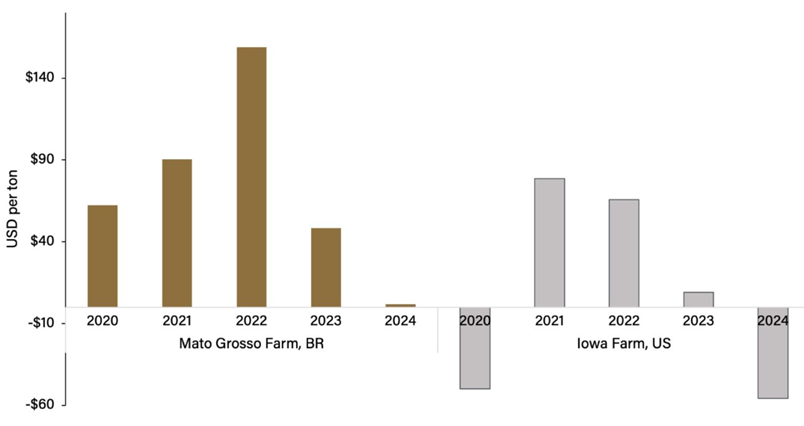
Figure 1 shows the economic profits for the representative farms during the period. As can be seen, profits on Brazilian farm outperformed those on the U.S. farm. Colussi and Langemeier note, “Although Brazil had significant cost increases between 2021 and 2022, strong soybean prices, local currency depreciation, and robust export demand helped sustain profitability during that period. Meanwhile, U.S. soybean production generated strong margins in 2021 and 2022 but faced tighter or negative margins in other years, reflecting rising operating costs, high fixed land expenses, and sensitivity to market price fluctuations.”
The analysis shows soybean production in Brazil is highly competitive with the U.S. and the advantage in recent years has gone to Brazil. Colussi and Langemeier say ongoing infrastructure improvements may reinforce Brazil’s cost advantage in the future. “Maintaining U.S. competitiveness,” they say, “will depend on productivity gains, cost management, and risk management strategies in an environment of input price uncertainty and strong global competition.” Just like the U.S. baseball team in the World Baseball Classic, U.S. soybean farmers face stiff competition from Brazil. The USA baseball team overcame their Brazilian counterparts. The competition for U.S. farmers, though, might be more fierce.