

Commercial Farms Drive Nebraska Agriculture


Nebraska farms with more than $250,000 in receipts account for a greater share of farms in the state compared to the average share in rest of the U.S. Not a surprise given the sizable role played by production agriculture in the state. The USDA Economic Research Service (ERS) defines farms with gross cash income (receipts from crop or livestock sales plus government payments) of at least $350,000 to be “commercial” farms. Commercial farms are generally thought of as large-scale crop or livestock operations run for a profit rather than for personal consumption or a hobby. TheFarmingHub website says, “commercial farming combines advanced machinery, modern irrigation systems, and data-driven crop management to maximize production. These operations often specialize in a few high-demand crops or livestock products . . . allowing them to scale quickly and serve global trade networks.”
Data from the 2022 USDA Census of Agriculture provides insights into commercial farms in Nebraska. Unfortunately, the Census does not separate out data for farms with gross receipts of $350,000 or more. Instead, it classifies farms using thresholds of $250,000 and $500,000. Thus, for purposes of this investigation, data is presented for Nebraska farms with receipts of greater than $250,000 and $500,000 to get a sense of the scale of commercial farming in Nebraska.
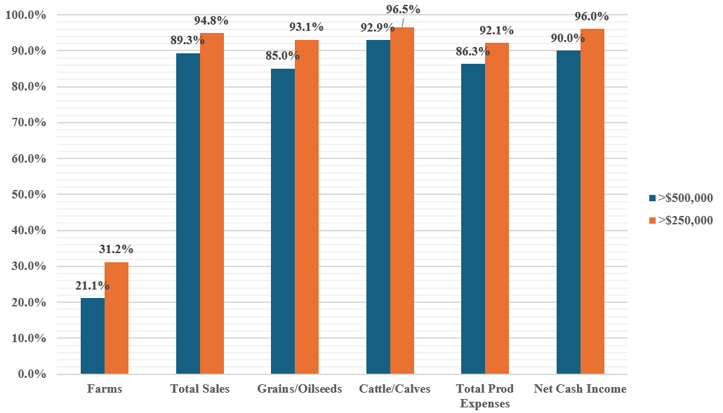
Farms with receipts greater than $250,000 and $500,000 make up 31% and 21% of Nebraska’s farms, respectfully (Figure 1). In comparison, the share of farms in these categories in the U.S. is just 14% and 9% of total farms. Commercial farms in Nebraska accounted for more than 89% of total sales of agricultural goods, more than 85% of crop sales, and more than 93% of cattle/calf sales. Dialing in a bit further, farms with $1 million or more in receipts, 5,218 farms or roughly 12% of farms accounted for 79% of the market value of agricultural products sold in 2022. Farms with receipts greater than $250,000 accounted for 77% of the land in farms in Nebraska and 80% of the value of land and buildings. Clearly the “80-20 rule”, also known as the Pareto Principle where 80% of outcomes come from 20% of causes, is alive and well in Nebraska agriculture.
Figure 1. Commercial Farms Drive Nebraska Agriculture
Source: Rolling Prairie Economics graphic using data from the 2022 USDA Census of Agriculture
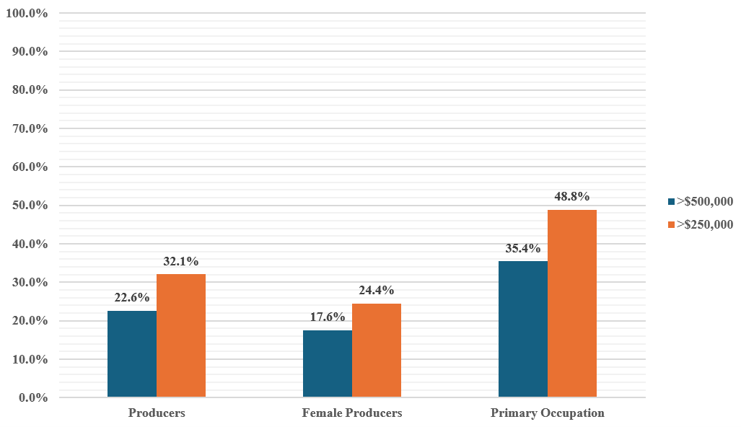
Figure 2 provides details on producers operating Nebraska’s commercial farms. Farms can have multiple producers. More than 82,000 producers were on the state’s 44,479 farms in 2022, a ratio of almost 2:1. The share of producers on farms with receipts greater than $250,000 and $500,000 was 23% and 32%, respectively. The share of female producers on commercial farms relative to all female producers, 18% and 24%, was less than the overall female share of total producers, 33%. And somewhat counterintuitively, of the roughly 40,000 Nebraska producers who indicated farming was their primary occupation, 49% were on farms with more than $250,00 in receipts and just 35% were on farms with more than $500,000 in sales. One would expect a greater share of producers on commercial farms to indicate farming was their primary occupation.
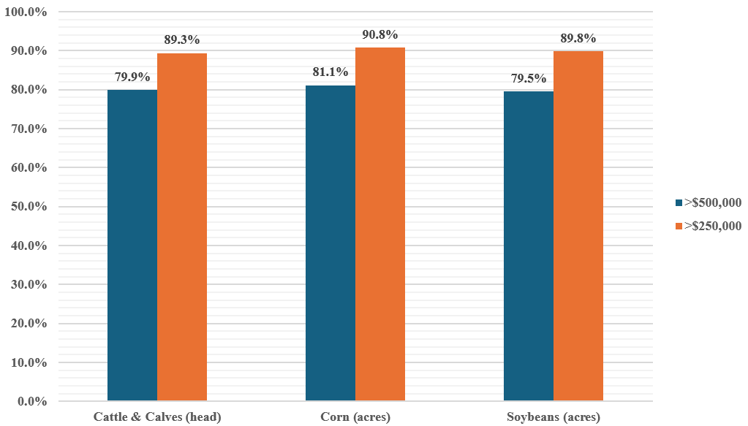
Commercial farms in Nebraska also dominate crop and livestock production (Figure 3). More than 80% of the state’s cattle and calves are found on farms with greater than $250,000 in receipts. And commercial farms account for more than 80% of the corn and soybean acres.
Figure 2. Nebraska Commercial Farms — Producers
Source: Rolling Prairie Economics graphic using data from the 2022 USDA Census of Agriculture
Figure 3. Nebraska Commercial Farms — Production
Source: Rolling Prairie Economics graphic using data from the 2022 USDA Census of Agriculture
The trend towards larger farms is accelerating. In 2022, farms with receipts greater than $500,000 had increased 232% relative to 2012. Nebraska’s commercial farms are highly specialized, mechanized, data-driven, and competitive in a global marketplace, making Nebraska a top agricultural state. Clearly commercial farms drive Nebraska agriculture.