

Consumers Still Demand Beef

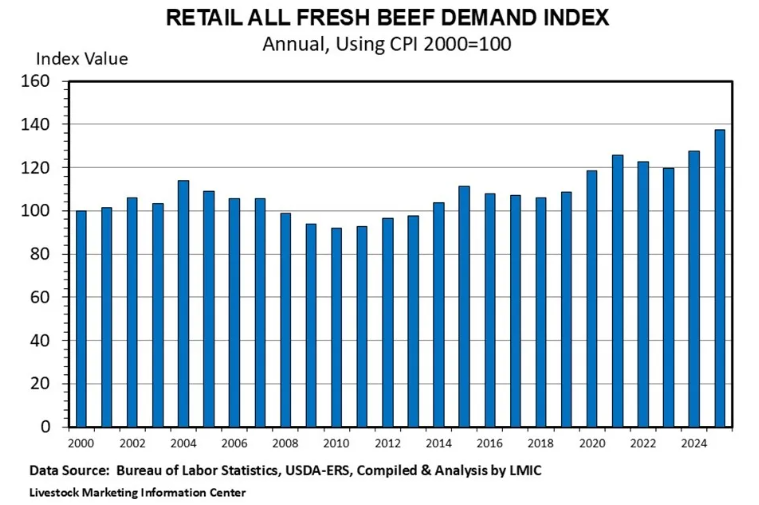
Consumer demand for beef continues to grow and is reaching record levels. An index created by the Livestock Marketing Information Center (LMIC) to gauge beef demand clocked in at 138 last year, the highest on record and a 10-point jump over 2024. The index is a function of price elasticity for beef, retail prices, per capita beef consumption, and the Consumer Price Index. The index’s baseline is 2000. The higher the index compared to 2000, the stronger the beef demand compared to that year. Figure 2 shows annual readings for the index since 2000. According to Tyler Cozzens, Director of LMIC, a 10-point jump has only occurred two other times in the last 25 years, from 2003 to 2004, and from 2019 to 2020. Cozzens also noted the index has increased 30 points, or 27%, since 2019.
Figure 2. Livestock Marketing Information Center Beef Demand Index
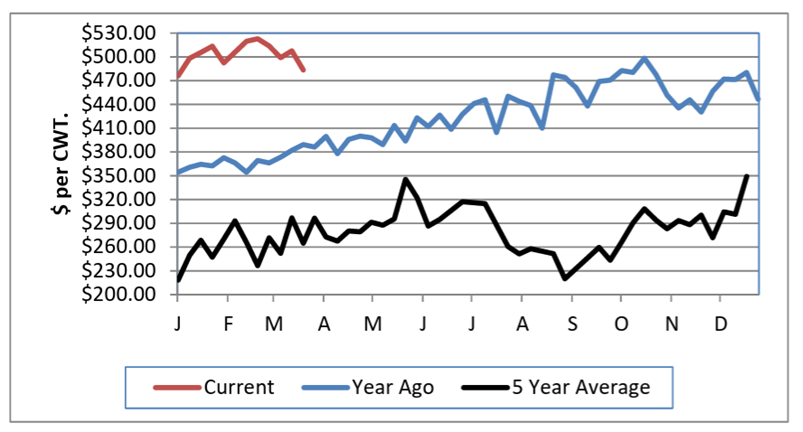
The strong and resilient demand has contributed to record high feeder steer prices in Nebraska. Prices for 500-600 lb. steers approached nearly $530/cwt. earlier this year and averaged around $483/cwt. for the week ending March 20. While off from earlier highs, the latest prices are still 59% higher compared to the same week last year. Prices for fed steers are also higher compared to last year, $235/cwt. versus $214. Also contributing to higher cattle prices is the low supply of cattle. U.S. calf numbers have declined over the past seven years, and Nebraska has been no exception. Nebraska’s calf crop in 2025, 1.50 million head, was down 17% from 2018. Last year’s calf crop in Nebraska was the smallest in at least 36 years.
Figure 3. Weekly Average 500-600lb Feeder Steer Price, Nebraska
Consumers keep buying beef despite higher prices. Between February 2025 and February 2026, beef prices rose 14.4%. The question is whether consumer buying will remain robust if the economy falters. Research by Glenn Tonsor and Justin Bina found that “financial sentiment may be even more influential on meat demand than income itself. To para phrase, income stability (ideally growth) is likely necessary but not itself sufficient for meat demand support if the public is highly concerned about their finances.” In other words, consumer sentiment regarding their finances weighs heavily into beef purchasing decisions. Surveys have shown consumers are increasingly pessimistic about the economy. Waning consumer sentiment could mean a slowdown in beef demand, although consumers’ beef demand has seemed unaffected by economic concerns thus far. Either way, beef demand bears close watching.