

Dollar Creates Headwinds for Exports

The dollar recently hit its highest level in more than a year creating headwinds for U.S. agricultural exports by making U.S. goods more expensive. Global investors continue to look favorably on the U.S. currency because of its role as a haven from global risks, potential higher U.S. interest rates, and the demand for dollars to invest in artificial intelligence. The U.S. dollar index, which tracks dollar’s value against a basket of six major global currencies, has gained more than 3.3% this year building on previous growth this decade. One consequence is a growing trade deficit in agricultural goods for the U.S. beginning in 2022 reaching $41 billion in 2025.
Figure 1 shows changes in the value of the dollar compared to currencies of Nebraska’s largest agricultural customers since early 2021. Apart from the Mexican peso, against which the dollar has depreciated 14.4%, the dollar has appreciated against the currencies of all other key trading partners ranging from 6.3% versus the European Union Euro to 70% gain relative to the Japanese yen. The Economist reported last week the yen hit a 40-year low versus the dollar recently. Fortunately, competitors in global agricultural markets like Brazil and Argentina have seen their currencies appreciate too, partially mitigating the negative effects of the dollar’s rise.
The dollar’s appreciation can also be seen in trade-weight exchange rates for specific commodities. Figure 2 shows trade-weighted exchange rate indexes for Nebraska’s three largest commodity exports (corn, soybeans, and beef) and the overall trade-weighted rate for U.S. agricultural exports. The indexes show the appreciation of the dollar against the currencies of importers of corn (+17%), soybeans (+24%), and beef (+24%). The overall trade-weighted index for agricultural exports has risen 16%.
Figure 1. Change in Dollar vs. Other Currencies (Jan. 2021-April 2026)
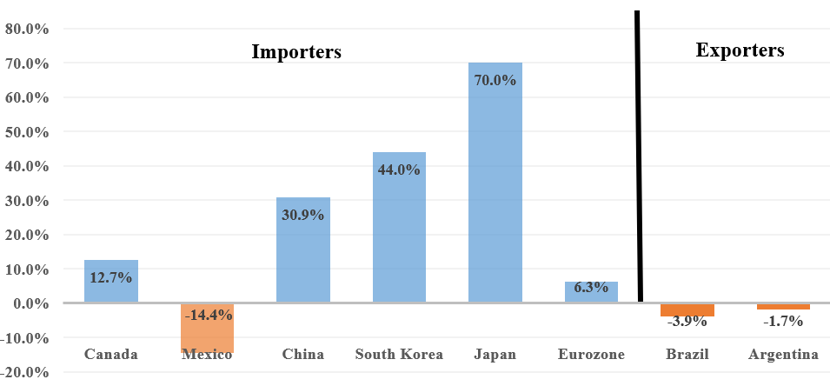
Figure 2. Real Commodity Trade-Weighted Exchange Rate Indexes

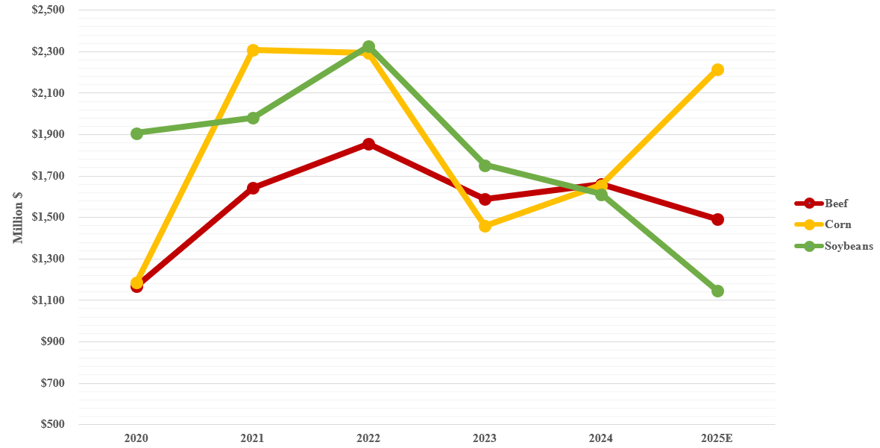
The effects of the dollar’s appreciation are seen in Nebraska export figures (Figure 3). After rising in 2021 and 2022, Nebraska’s exports have fallen since. Estimated Nebraska beef sales in 2025 were 20% less compared to 2022. Soybean sales too have declined, falling an estimated 50% from 2022. Corn exports are an exception, falling in 2023 but rebounding last year to almost equal 2022 sales. The depreciation of the dollar against the Mexican peso explains part of the rebound. Mexico purchases roughly 40% of U.S. corn exports and its purchases were up 20% in 2025 compared to 2022. The depreciating dollar against the peso makes U.S. corn less expensive. The appreciation of the dollar against the Japanese yen has contributed to fewer exports to Japan. U.S. exports to Japan were down 12% in 2025 compared to 2022. To be sure, other factors, like supply, demand, economic conditions, and geopolitics also played a role in reducing U.S. exports, but the dollar’s appreciation was a player too.
The foreseeable future points to more of the same for the value of the dollar. The strength of the U.S. economy, global uncertainty, continued inflation, and the potential for higher interest rates portend of a continued strong dollar. The headwinds created by a stronger dollar will continue to hinder U.S. agricultural exports.
Figure 3. Nebraska Exports of Beef, Corn, & Soybeans (2020-2025E)
Source: Rolling Prairie Economics graphic using data from the USDA Economic Research Service.