Drought Remains an Unwelcome Guest

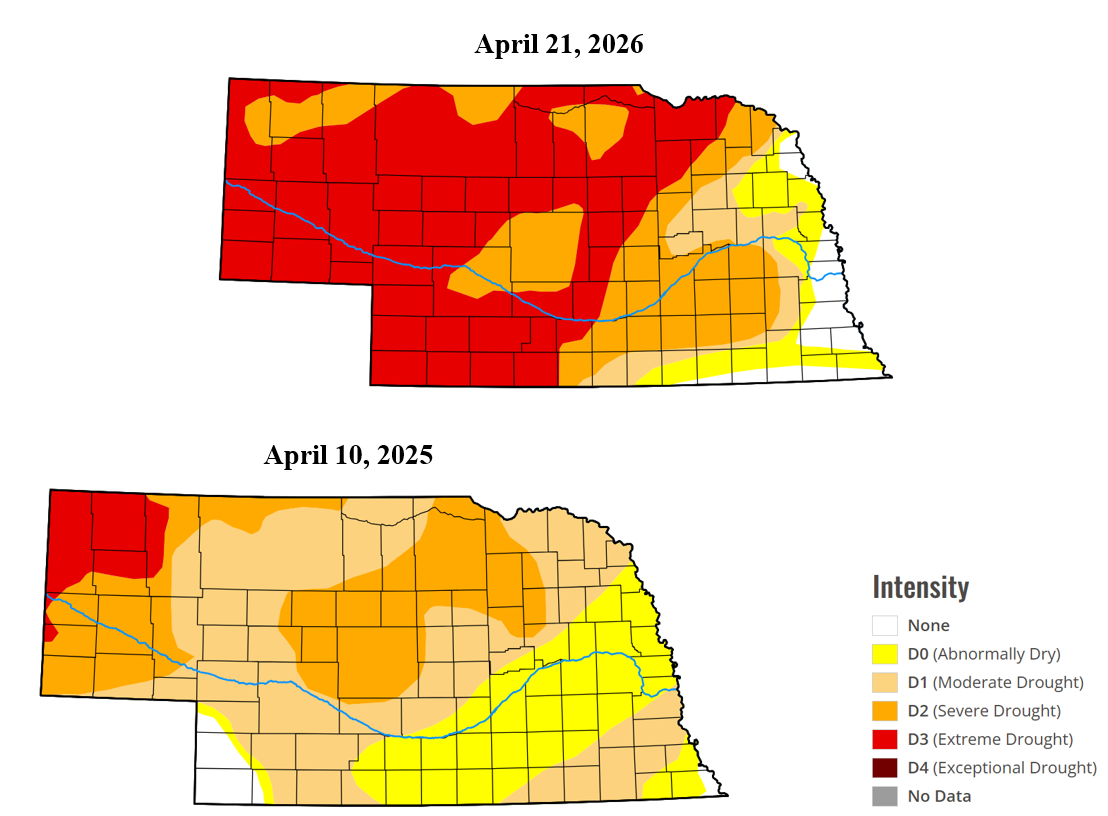
Like the guest who doesn’t take cues on when to leave, drought remains firmly entrenched in Nebraska and is expanding to take over more of the house. Figure 2 compares drought maps between April of this year and last year produced by the UNL Drought Mitigation Center. While there has been a slight improvement from last year, drought only covers 95% of the state compared to 97% last year, conditions this year are markedly worse. The area covered by severe, extreme, or exceptional drought conditions (D2-D4) is significantly larger this year. Last year 34% of the state was under severe or worse conditions. This year 82% of the state suffers under such conditions. The worsening of conditions shouldn’t come as a surprise. According to Nebraska Public Media, the National Weather Service reported that Nebraska recorded its third-warmest winter since the Dust Bowl years in the 1930s. Eric Hunt, University of Nebraska-Lincoln agricultural meteorologist, says that when considering both temperature and moisture, the 2025-26 winter was starkly worse.
Figure 2. Nebraska Drought Monitor Maps
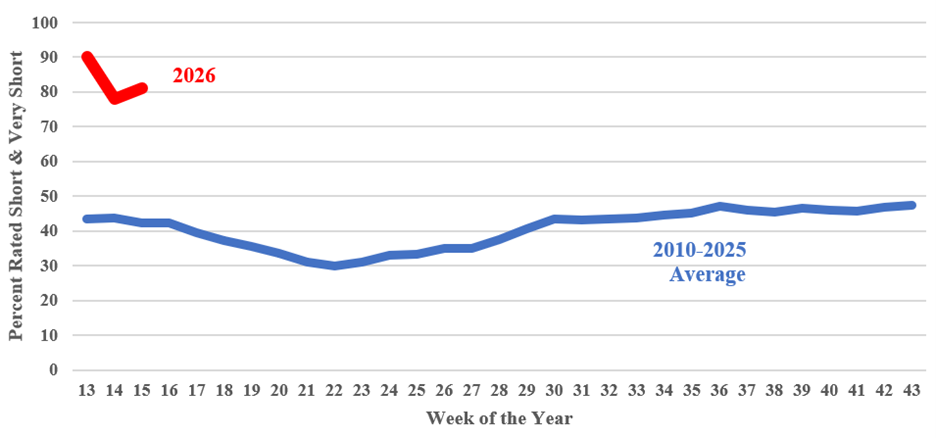
The effects of drought can be seen in soil moisture ratings. Figure 3 shows the combined weekly subsoil “very short” and “short” moisture ratings this year compared to average ratings during the growing season between 2010-2025. Over the period the combined short and very short ratings averaged between 29%-49% during the growing season, with the latter half of the year being drier than the first. Average subsoil moisture ratings during planting season range between 35% to 45%, higher than one would expect, but an indication of how often Nebraska teeters with drought. Ratings this year are considerably worse than average nearly double the average — 83% of the state’s subsoils rated short or very short for moisture compared to the average of around 42%.
Figure 3. Percent of Subsoil Moisture Rated “Short” & “Very Short”
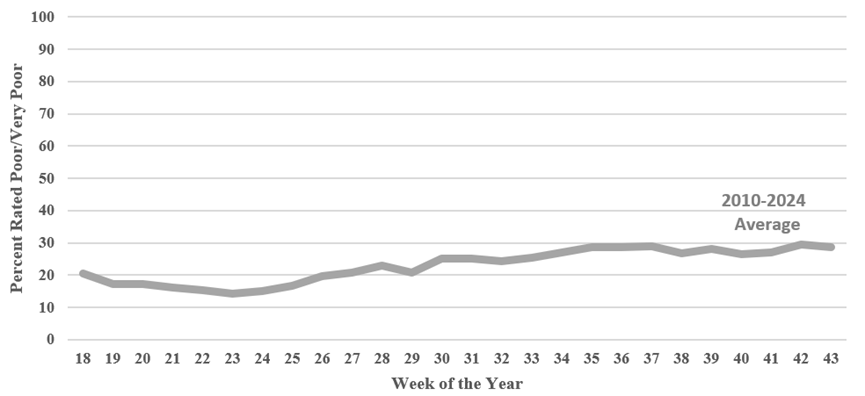
History has shown a link between drought conditions and the number of wildfires. Thus, this year’s spate of wildfires is also evidence of worsening drought and poor pasture conditions. Figure 4 shows combined weekly “poor” and “very poor” average pasture ratings from 2010-2024. Poor and very poor pasture conditions, on average, ranged between 14%-29% during the growing season in the past. USDA does not report pasture conditions until early to mid-May. Given current conditions, though, there’s no doubt they will be worse than average too.
This weekend’s precipitation might help some parts of the state. But Mother Nature doesn’t appear to be in the mood to offer much help. The National Oceanic and Atmospheric Administration (NOAA) outlook for May through July shows “leaning below” normal for chances of precipitation for the state, providing little hope for a break. Drought means greater expenses for irrigators, potentially less yields, and stocking and forage management challenges for ranchers. Unfortunately, Nebraska’s unwelcome visitor is in no hurry to move on. It appears farmers and ranchers need to prepare and plan for drought’s extended stay. More information on the drought and how it compares to previous ones can be found at: https://nebraskaexaminer.com/2026/04/27/nebraska-grapples-with-warmest-driest-drought-on-record/.
Figure 4. Percent of Pasture Rated “Poor” & “Very Poor”