

Fewer Cattle Equals Less Beef


Media and market analysts closely monitor crop production and demand estimates in the USDA World Agriculture Supply and Demand Estimates (WASDE). Sometimes overlooked, though, are WASDE projections for livestock and meat supply and demand. Nebraska, a major cattle- and beef-producing state, figures prominently in the beef projections.
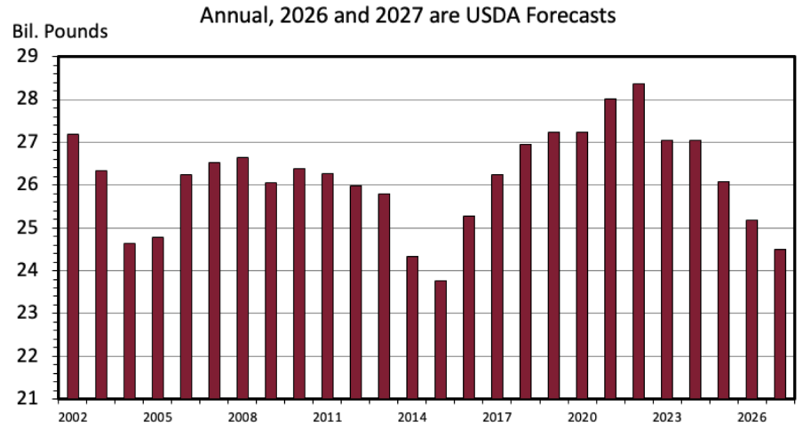
October’s WASDE report reduced beef production estimates for both this year and next. Production for this year was forecast at 24.8 million pounds. Next year was pegged at 24.7 million pounds. Josh Maples of Mississippi State University said it was the eighth consecutive month USDA had lowered the production forecast for this year. It is now projected to be 4.6% below last year and the smallest in 11 years. Production reached a peak of more than 28 billion pounds in 2022. Carcass weights are heavier this year, up 2.3% year-to-date according, to the Daily Livestock Report, but heavier weights haven’t offset lower slaughter numbers. The Daily Livestock Report said year-to-date federally inspected slaughter is off 7.2% compared to last year. The recent opening of the Mexican border to cattle imports could affect production projections moving forward, but while it could add to supply, any effect would likely be minimal.
Figure 4. U.S. Beef Production
World beef production is also forecast to be down slightly. Derrell Peel, livestock economist with Oklahoma State University, reported the USDA Livestock and Poultry: World Markets and Trade Report showed global beef production for 2027 at 60.031 billion metric tons, down a bit from 60.2 billion pounds this year. Besides the U.S., lower production is forecast for Brazil, China, the European Union, Australia, Russia, and South Africa. India, Argentina, Mexico, and Canada are expected to see increased production. Brazil is expected to remain the largest beef exporter. The U.S. is projected to be the fourth-largest exporter, accounting for 7.6% of the world’s total. China will remain the largest importer, followed by the U.S. with imports of 2.80 billion pounds, off from this year’s 2.88 billion pounds.
On a related note, the October Cattle on Feed report pegged the feedlot inventory in Nebraska at 2.55 million head, the same as a year ago but 3% above September. The U.S. inventory was 11.372 million head, slightly less than a year ago. Placements in September were a record low for the month, down 12.1% year-over-year. Nebraska saw the largest decline at 95,000 head, down 16% from September 2025.