

Higher Farm Income, But

Deteriorating farm financial conditions are troubling producers, elected officials, agricultural economists, and others involved in agriculture. Repeatedly, concerns are heard about negative returns, dwindling working capital, mounting debt levels, and rising costs. Actual numbers on financial conditions on Nebraska farms, though, have been few. Fortunately, Nebraska Farm Business, Inc., (NFBI), a Nebraska Farm Bureau member benefit partner, remedies that. NFBI helps farms track financial figures then compiles and analyzes the data for an annual report. Recently, Tina Barrett, director of NFBI, and Flint Corliss, associate farm financial consultant, shared NFBI’s figures for 2025 on a webinar sponsored by the Center for Agricultural Profitability at the University of Nebraska. The upshot of their report: net farm income was higher in 2025 compared to previous years, but long-term financial challenges may be brewing.
The average farm income for Nebraska farms working with NFBI rose to approximately $170,000 last year. It was the second consecutive year of growth. The increase was driven by returns to livestock operations — 17% of farms were heavily involved in livestock and government payments. The median return for livestock operations was 5 times greater than that for crop operations. About 32% of farms had negative returns, like levels seen in 2024 but less than those seen in 2023. The cost to raise irrigated corn and soybeans in 2025 drifted lower, averaging $5.08/bushel for corn with a yield of 230 bushels and $12.73/bushel for soybeans with a yield of 80 bushels. But while costs moderated a bit, receipts failed to cover the costs. Thus, for the third consecutive year, crop producers experienced negative margins. Government payments helped many crop producers avoid worse losses.
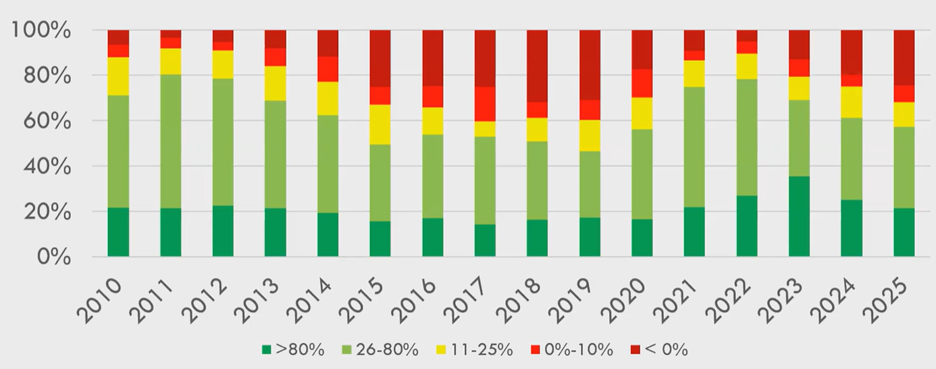
A troubling aspect of the report was the softening NFBI reported in indicators of farm financial health. Liquidity ratios measure the ability of operations to cash flow in the short-term, the next 12 months, and solvency ratios measure look at financial health for the long-term, beyond 12 months. NFBI uses a ratio of working capital-to-gross revenues to measure liquidity. A ratio below 10% signals trouble while one above 30% is considered good. Barrett said the ratio is like a blood pressure reading — it can change quickly but be an early gauge of trouble. The average ratio last year was 25%, down 8 percentage points from 2024 and down more than 15 points from 2023. It now falls in the caution range between short-term financial strength and liquidity problems. Perhaps more concerning is the number of producers, 32%, with ratios of less than 10% and the 25% with negative ratios (Figure 1). On a positive note, 57% of farms finished the year with good ratios.
Figure 1. Working Capital-to-Gross Revenue Ratio, % of Farms in Each Category
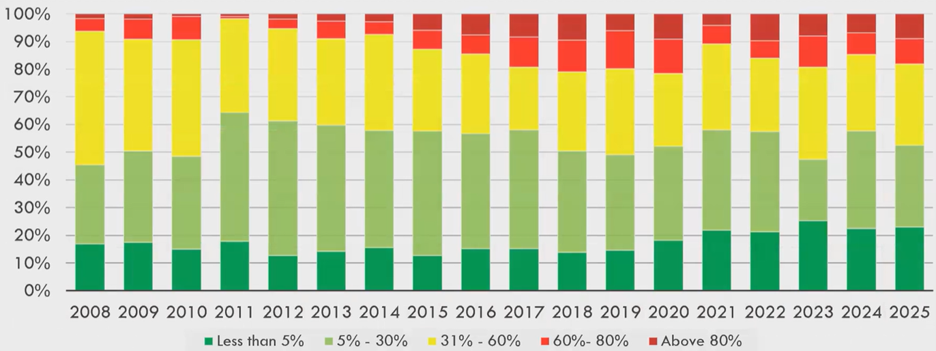
NFBI uses a debt-to-asset ratio as an indicator of farms’ long-term solvency. A ratio above 60% indicates trouble while one below 30% shows strong financial health. Barrett compared the solvency ratio to a cholesterol level. It takes a bit to change the level and higher readings can point to long-term troubles. Last year, the average ratio was 34%, rising from 25% in 2022. Like the liquidity ratio, it fell in the caution range between the good and bad thresholds. While there has been some vacillation in recent years, the share of producers in the yellow or red categories has remained steady, meaning farms’ long-term financial health remains stable.
Figure 2. Debt-to-Asset Ratio, % of Farms in Each Category
NFBI figures suggest producers, primarily crop producers, are seeing liquidity concerns rise. Long-term financial health has softened but overall appears stable and in somewhat decent condition. Each year of negative returns, though, ratchets up the financial stress. Economic conditions like today’s have tested farmers before and they have proven resilient. Management skills will be a premium. The webinar can be found at: https://cap.unl.edu/2025-farm-averages-webinar/. To purchase NFBI’s annual report, go to: https://nfbi.net/