

Inflation Heats Up


Inflation continues to be a top-of-mind concern for consumers. University of Michigan researchers said cost-of-living concerns and surging gasoline prices weighed heavily on consumer sentiment in May, causing its index to hit a record low of 44.8. At the same time, rising input costs are a top-of-mind concern for agricultural producers. A May survey of 400 farmers for the Purdue University-CME Group Ag Economy Barometer Index found that 51% of participants listed high input costs as their biggest concern and 46% said high costs are limiting improvements in their finances.
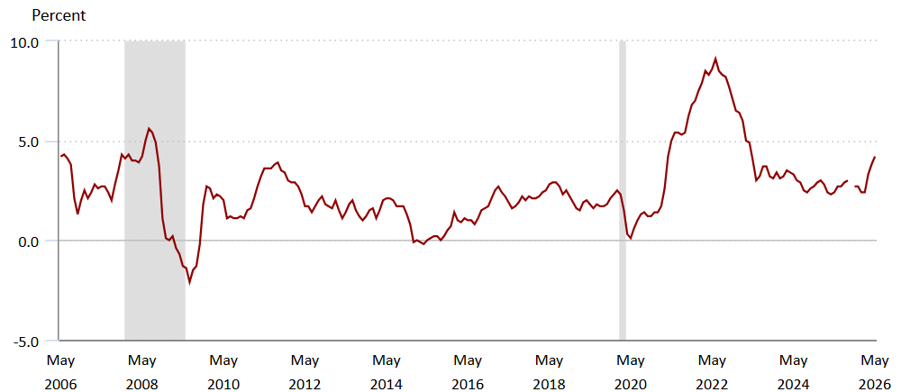
Thus, the latest inflation figures are not going to improve the mood of either agricultural producers or consumers. The Consumer Price Index (CPI) was 4.1% for the 12 months ending in May, up from 3.8% in April, and rising above 4.0% for the first time in three years (Figure 3). The core inflation rate, which excludes the more volatile food and energy prices, rose 2.9%. Rising energy costs were the primary culprit in the rising CPI. The energy index accounted for over 60% of the monthly CPI increase. Over the past year the energy index has increased 23.5%.
Figure 3. Consumer Price Index, 12-Month Percentage Change
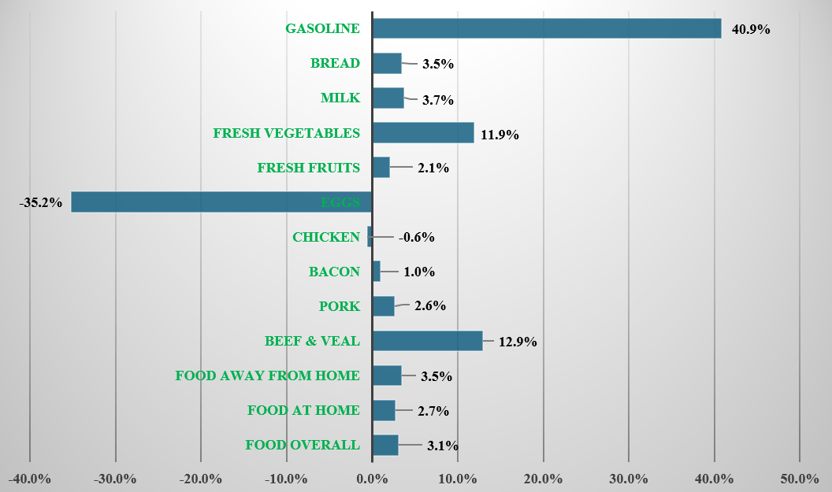
The inflation rate in May for all food was 3.1%, with the rate for food at home (2.7%) less than food away from home (3.5%). Among food items, prices for beef and vegetables had the largest increases, with rates of nearly 13% and 12%, respectively. Egg prices, last year’s inflationary concern, fell more than 35% over the past year and prices for chicken were also off slightly. Gasoline prices, though, have risen 41% over the past year.
Figure 4. Annual Inflation Rates for Selected Goods, May 2025 to May 2026
The Producer Price Index (PPI), also released last week, is heating up as well. The PPI tracks inflation from the perspective of manufacturers, farmers, and service providers. It gauges the price of goods and services as they leave producers and before they reach the consumer. Year-on-year, the PPI has risen 6.5%, the most since November 2022.
Other economic figures, however, paint a better picture of the economy. The unemployment rate remains relatively low at 4.3%. About 172,000 non-farm jobs were added in May, above economists’ expectations, and estimates show gross domestic product (GDP) grew 1.6% in the first quarter.
President Trump seemed unconcerned with the inflation news, saying “the numbers are great” and “I love the inflation.” He later said he meant he was glad inflation wasn’t higher. No doubt, the Federal Reserve did take notice of the news. The central bank has a mandate to keep prices stable with an annual inflation rate goal of 2%. Thus, most observers expect it to hold the line on interest rates when it meets this week. The latest numbers have shifted market expectations for the remainder of the year from rate cuts to rate hikes. Agricultural producers, already taking on more debt to weather current conditions, could face higher interest rates and continued upward pressure on input costs. Rising inflation could also dampen consumer spending, which could pressure the demand for beef. However, a cease in the conflict with Iran, or a removal of tariffs, could ease the price pressure. Either way, inflation is just another of the plethora of challenges producers are facing this year.