Interest Rate Hike — Now What?

Two weeks ago, the Federal Reserve raised the federal funds rate 0.25% to a range of 3.75-4.00%. It’s the first rate hike in three years. Presumably, the decision was made to combat inflation, which has been consistently running above target. The bank’s long-run inflation target is 2%. The central bank uses the price index for personal consumption expenditures (PCE), not the consumer price index (CPI), as its measuring stick for inflation and the latest reading from July clocked inflation at 3.7%. It had been sitting on rates hoping that inflation pressures from the wars in Iran and Ukraine and trade conflicts would be temporary. The decision to hike rates suggests members of the rate setting committee are worried the causes are not temporary and inflation could become embedded in the economy.
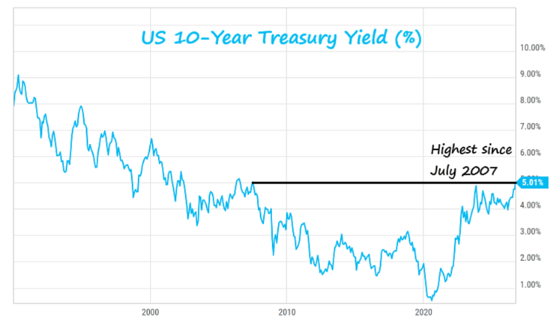
Also, the 10-year Treasury yield hit 5.2% last week, the highest level since 2007. And the 30-year Treasury yield hit its highest level since 2004. Concerns with inflation, rising government debt, and competition from private companies needing capital to finance AI infrastructure are driving yields higher. Given the underlying causes, there is little reason to expect rates to turn lower anytime soon.
Figure 1. 10-Year Treasury Yield
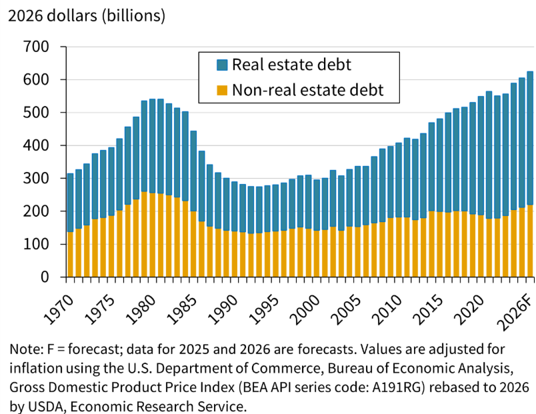
Interest rate hikes and rising treasury yields mean growing interest expenses for farmers and ranchers. Inflation adjusted farm debt has increased dramatically over the last 25 years, much of it in the form of real estate debt, but operating debt has increased too (Figure 2). The U. S. Department of Agriculture forecasts total inflation-adjusted debt this year at $624.7 billion, up 5.2% from 2025 and the highest on record. Borrowing costs for operating loans, loans used to finance purchases of livestock or land, and loan refinancing will rise. Higher rates might also weigh on farmland values.
The effects of higher interest rates will vary among operations. Those with strong balance sheets, cash reserves, and fixed-rate debt are better positioned to deflect the higher expenses. Highly leveraged operations dependent on variable-rate credit will be affected most. Overall, farm balance sheets remain strong and operations are financially stable. Higher interests rates, though, will add to the plethora of rising costs faced by the sector, a continuing concern for producers.
Figure 2. U.S. Farm Sector Debt (inflation-adjusted)