

Modest Stress on Farm Finances


“This survey is hard to answer as there is a significant difference between the farmers and ranchers. Farmers are struggling significantly while ranchers are doing well this year.” That’s one Nebraska lender’s comment on a survey by the Federal Reserve District of Kansas City regarding agricultural credit conditions in the Tenth District. The comment reflects the continuing dichotomy in agriculture today. Cattle producers are seeing record high prices and are financially performing well. Crop producers continue to struggle to earn positive returns.
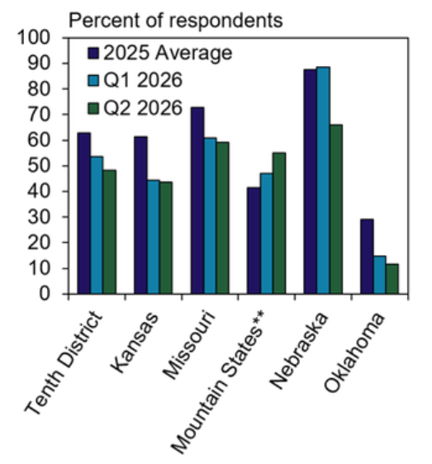
Overall, responses to the survey showed farm income “remains subdued,” but the pace of decline slowed “slightly.” Figure 2 shows the share of lenders reporting lower farm incomes for the first two quarters of 2026 compared to 2025. Fewer lenders reported lower farm income in the second quarter compared to the previous two periods, dropping from over 60% last year to just under 50% this year. A similar decline is seen in responses from Nebraska lenders. Between 80-90% reported lower income last year to less than 70% this year. Ty Kreitman, an economist with the Federal Reserve, wrote that slightly higher crop prices and record highs for cattle prices were factors in the improved income prospects. Another Nebraska lender noted federal government payments as a positive factor too.
Figure 2. Share of Lenders Reporting Lower Farm Income
Source: Ty Kreitman, Steady Tightening of Agriculture Credit Conditions Persists, Center for Agriculture and the Economy, Federal Reserve Bank of Kansas City, August 14, 2026.
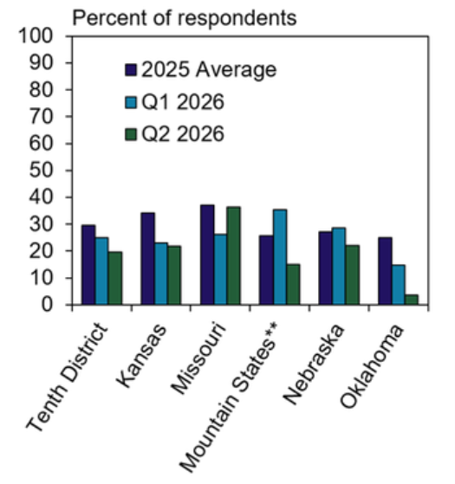
Loan repayment rates also improved with fewer problems in the first half of this year compared to last year. Lenders indicated that less than 10% of farm loan balances had major or severe repayment problems and only about 15% had minor troubles. Repayment issues dipped in Nebraska too but remain slightly higher when compared to other states. This is not new. Repayment issues in Nebraska always seem to be a bit more pronounced relative to other states. Perhaps the heavy presence of livestock feeding and irrigation in the state lends to more issues.
Figure 3. Share of Lenders Reporting Lower Loan Repayment Rates
Source: Ty Kreitman, Steady Tightening of Agriculture Credit Conditions Persists, Center for Agriculture and the Economy, Federal Reserve Bank of Kansas City, August 14, 2026.
Lenders also reported financial conditions for smaller farms. About 35% of lenders reported conditions were weaker for farms with less than 1,000 acres. And those operating on primarily rented land were weaker compared to ones operated by owner-operators. Half of lenders indicated farms operating primarily on rented land were weaker. Overall, though, farm financial conditions steadied in the second quarter. Kreitman wrote, “Agricultural credit conditions continued to deteriorate gradually in the second quarter of 2026, but the level of financial stress was modest . . .” More information can be found at: https://www.kansascityfed.org/agriculture/ag-credit-survey/steady-tightening-of-agricultural-credit-conditions-persists/