

Net Farm Income Leaps


Livestock receipts and federal government payments underpinned a leap in Nebraska net farm income last year. The U. S. Department of Agriculture (USDA) Economic Research Service (ERS) estimates nominal (non-inflation adjusted) net farm income in Nebraska was $8.12 billion in 2025, a 34% increase over the prior year (Figure 1). It was the third time income exceeded $8 billion, and the third-highest in history in nominal terms. The record is $9.3 billion, hit in 2023. Among states, real (inflation-adjusted) net farm income was highest in California at $26 billion, followed by Texas at $15 billion, Iowa at $10 billion, and Nebraska. According to the American Farm Bureau Federation, the four states accounted for more than 30% of the nation’s net farm income. The ERS pegged national net farm income at $238 billion, up just over 1% from 2024.
Nebraska’s total value of agriculture production last year was estimated at almost $38 billion, a record, rising almost 12% from 2024. Driving the rise were meat animal receipts, up 14%, and poultry and egg receipts, up 37%. Crop receipts were down 3%. Government payments also saw a marked increase, up almost $1 billion. Not surprisingly, expenses were higher too, up 11%. The largest increases were seen in livestock purchases, pesticides, and machinery hire and custom work.
Figure 1. Nebraska Net Farm Income (nominal dollars)
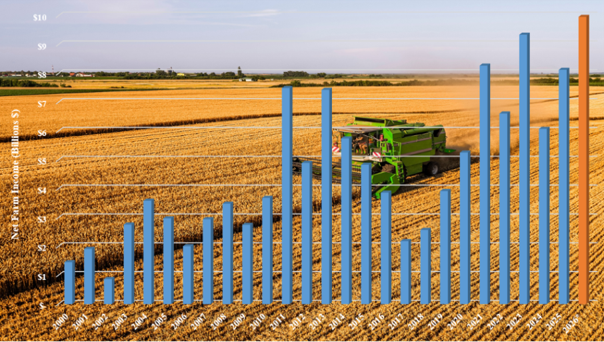
Source: Rolling Prairie Economics graphic; data from USDA Economic Research Service
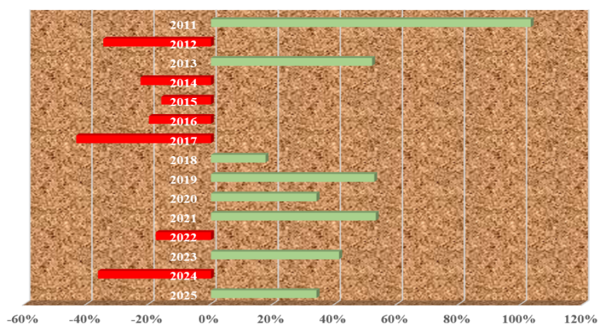
Last year continued a pattern of sizable annual swings in income since at least 2010 (Figure 2). The average percentage change over the 15-year period in absolute terms was 39%, meaning that farmers must manage for significant year-to-year fluctuations in income. Weather, global events, politics, and international competition all contribute to the volatility which confronts farmers in all phases of their operations — production, marketing, purchasing inputs, and financial management. The volatility only adds to the complexity of managing farms and ranches in today’s agriculture.
Figure 2. Annual Percentage Changes in Nebraska Net Farm Income
The ERS’s September forecast predicted U.S. net farm income for this year would rise 2%. Again, positive returns for livestock producers and federal government assistance are expected to fuel the rise. Just last week, the USDA announced it will distribute $13.8 billion in federal farm payments this fall. Forecasts by economists at the Universities of Nebraska and Missouri last spring projected Nebraska net farm income could exceed $9 billion this year. Updated estimates, though, should be forthcoming this fall. The livestock sector and government payments will continue to support higher income, but positive returns for crop producers will be a challenge.