

Positive Ethanol Returns


Ethanol production is Nebraska’s third-largest agricultural sector, according to a study released by the University of Nebraska Department of Agricultural Economics and Bureau of Business Research last year. The state’s 24 ethanol plants produce more than 2 billion gallons of ethanol each year and, in the process, use the equivalent of 40-50% of the state’s corn crop, produce 6 million tons of livestock feed, and, because almost all the ethanol produced is exported out of the state, bring dollars into the state. The sector’s performance is important for the state’s agricultural economy as well as the overall economy.
How did the sector perform in 2025? Figure 1 shows estimated ethanol operating margins for a representative 100-million-gallon facility in Iowa from the Center for Agricultural and Rural Development (CARD) at Iowa State University. Operating costs for the plant are split between the cost of corn (orange area), about 80% of the cost, and other costs (green area). The blue area shows the returns over operating costs. The horizontal line represents the estimated per-gallon capital costs. Profits are implied when operating returns exceed the horizontal line.
Figure 1. Ethanol Operating Margins, Representative Iowa Plant
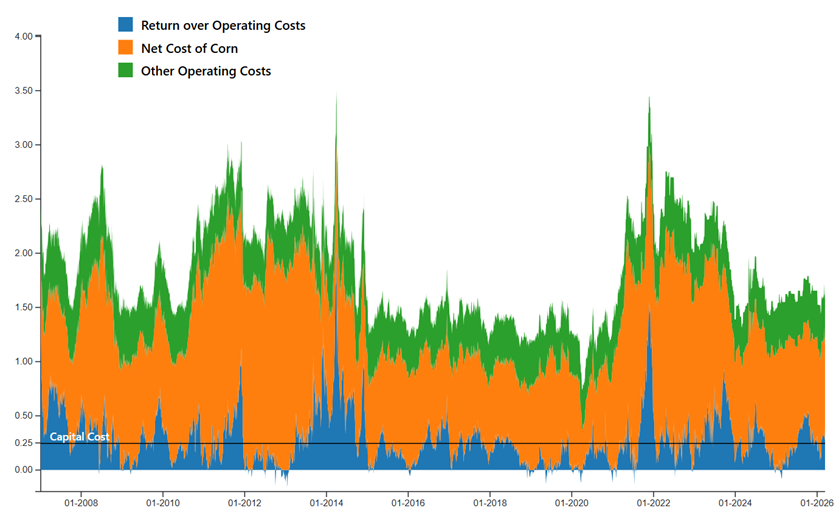
As Figure 1 shows, last year, ethanol plants saw returns above operating costs for much of the year. While the estimates apply to production in Iowa, one can surmise the returns for plants in Nebraska were similar. Scott Irwin, a biofuels expert with the University of Illinois, noted, “Net profits ranged widely in 2025, from a low of -$0.05 to a high of $0.56 per gallon. Overall, there was a sharp uptrend in profits throughout the year, with the peak of $0.56 being reached in October. Net profits for 2025 averaged $0.21 per gallon, well above the historical average of $0.13 since 2007.”
Looking forward, CARD estimates ethanol production will generate positive margins during at least the first part of the year. Prices for ethanol and co-products are moderately higher this year. Recently, the average ethanol price at plants in Nebraska was $1.61/gallon, compared to $1.56/gallon last year. The price for corn oil was $.70 per pound verses $.48. Distillers grains were priced at $173.00/ton compared to $161.50. Irwin says that returns will depend on the corn-to-ethanol price spread, obligatory volumes under the Renewable Fuel Standard (RFS), and the 45Z Clean Fuel Production Credit. Gasoline usage will also play a role. Higher fuel prices sparked by the Middle East war could mean less summer travel and fuel consumption. The outlook for ethanol is encouraging, but as with many sectors this year, the future holds considerable uncertainty.