Resilient Farm Finances


Financial conditions for agricultural producers continue to diverge between livestock and crop producers. Livestock producers, particularly cattle producers, are experiencing record high prices, lower feed costs, and possibly record returns. Crop producers continue to struggle with low prices and high input costs. The detection of New World screwworm, volatility in prices for diesel and fertilizer, increasing costs, and vacillating trade policy challenge all producers.
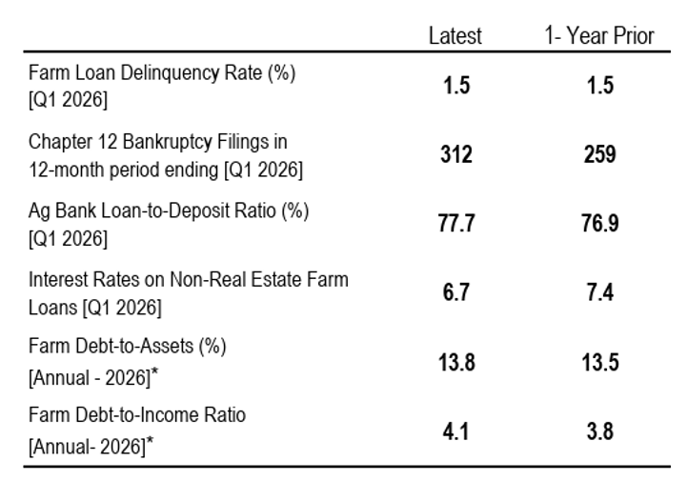
Through it all the farm economy remains resilient. Net farm income in Nebraska this year is projected to be a record due to federal government assistance payments and positive returns for cattle producers. Farmland values remain steady. And farm financial health indicators, while deteriorating, remain relatively strong. Table 1, from the Kansas City Federal Reserve, compares several indicators between this year and last year. The most notable deterioration is seen in farm bankruptcies. Filings rose to 312 over the previous 12 months prior to April compared to 259 in the year prior. Other indicators showed little change. The delinquency rate on farm loans remains low and has not changed from last year. Interest rates on non-real state farm loans are lower. Debt-to asset and debt-to-income ratios are up slightly compared to last year, suggesting producers are taking on more debt to sustain their operations.
A lender from southeast Nebraska was quoted in The Van Trump Report last week as saying that some producers “say that it feels like ag is increasingly becoming a game of managing variability rather than pursuing perfection” adding, “We’ve spent a good bit of time over the last few seasons seeking to understand the markets and better manage our risk.” No doubt many producers concur given the volatility and unpredictability of the last few years. Financial indicators suggest producers are finding ways to cope with an increasingly uncertain world.
Table 1. U.S. Farm Credit Conditions