Resilient Farm Finances


Farm finances remain stable despite profit challenges in the crop sector, although slight deterioration in some financial indicators has occurred. The USDA Economic Research Service (ERS) reported last month that total farm sector debt, including both real estate and non-real estate debt, is expected to reach a record $605 billion this year in inflation-adjusted dollars. Real estate debt is expected to reach $399 billion, a 4.6% nominal increase, and non-real estate debt to reach $206 billion, up 4.4%. The Federal Reserve Bank of Kansas City’s latest measurements also showed rising debt levels. It noted second-quarter increases in both non-real estate and real estate debt according to the commercial bank Reports of Condition and Income. Growth in non-real estate debt was particularly concentrated at agricultural banks—those whose farm loans account for at least 25% of gross loans. Gerald Mashange of the University of Illinois says agricultural loans at commercial banks in the second quarter were up 2.1% from the first quarter and 3.8% from a year ago.
These figures, though, do not capture the entirety of what farmers owe, according to Reuters. Farmers also borrow from suppliers, cooperatives, equipment manufacturers, seed companies, and other nontraditional lenders. It’s difficult for the USDA to measure farm debt to these sectors. Its latest estimate pegged such debt at $45 billion in 2025, but Jenny Ifft, a Kansas State University agricultural finance professor, estimates it could be two to three times that much.
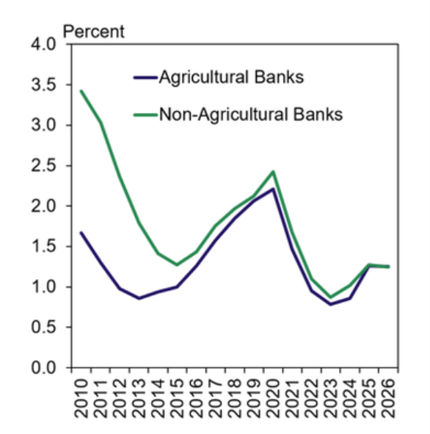
Yet, even with the growth in debt, measurements of the sector’s financial health remain stable. The Kansas City Federal Reserve said farm loan delinquency rates were “relatively low” in the second quarter and haven’t changed in the last year (Figure 1). The share of farm debt 30 days past due was “minimal or zero” at about half of agricultural banks. Only a quarter of banks reported farm delinquency rates above 1.4%. The USDA forecasts the overall debt-to-asset ratio for the farm sector to increase only slightly from 13.3% in 2025 to 13.5% this year. The increase is limited because the value of farm assets is forecast to increase too. Real estate values are forecast to rise 3.4% and non-real estate assets to decrease by 2.0%. A lower debt-to-asset ratio indicates lower financial risk and greater stability.
Figure 1. Farm Loan Delinquency Rates