September Slipup


Farmers and market analysts alike wondered aloud whether something was amiss after the USDA National Agricultural Statistics Service (NASS) production forecasts were released in October, particularly for Nebraska corn yields. NASS projected Nebraska’s average corn yield this year would be 188 bushels per acre, 11 bushels more than September. A sizable jump especially given the reality of what producers were seeing on the ground. Commentary focused on the October yield forecast as the one amiss as the September forecast seemed more in line with reality.
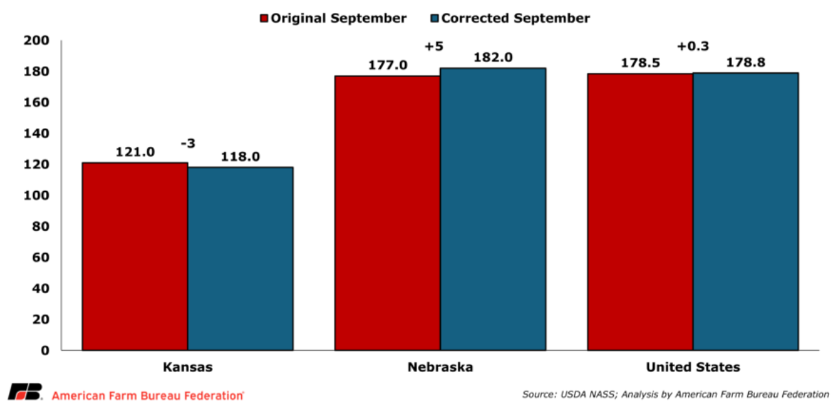
A comprehensive review by NASS of the corn estimation procedures, though, identified a processing error in the September estimates rather than October’s as initially thought. The error involved incorrect acreage weights used to combine irrigated and non-irrigated yield observations for Nebraska and Kansas. As a result, September yield forecasts for Nebraska were revised to 182 bushels per acre, up 5 bushels, and to 118 bushels for Kansas, down 3. The U.S. average corn yield was increased 0.3 bushels to 178.8. NASS also reviewed October’s estimation procedures and confirmed they were correct.
Accuracy and transparency in data reporting are vital. Faith Parum, American Farm Bureau Federation economist, notes, “Agricultural markets depend on reliable information to support transparent price discovery. Farmers make production, financing and marketing decisions based in part on the supply expectations reflected in USDA reports.” The September slipup renewed concerns about the accuracy of USDA reports. Confidence had already been tarnished by reporting miscues last year. Observers speculate the miscues could be due to staff reductions. According to a Nebraska Public Media report, NASS lost 37% of its staff last year due to budget cuts, the largest drop by percentage at any USDA agency.
USDA's forthrightness about the September error is an important step in maintaining confidence. The USDA also said it will implement additional pre-publication checks to verify and validate calculations. And it is evaluating further improvements to strengthen its quality-control procedures. The USDA has been the gold standard on agricultural information and data for its quality and transparency. It needs to remain so.
Figure 1. Original & Corrected USDA September Yield Estimates