

Slaughter Capacity & Price Spreads


The price spread between the cattle and wholesale box beef is monitored closely by producers and organizations worried about market power in the beef processing sector. When the spread widens, arguments will be heard the widening is indicative of the market leverage processors have. However, a recent Cornhusker Economics article by T. Jake Smith, an agricultural economist with the Department of Agricultural Economics at the University of Nebraska, suggests another reason for changes in the price spread — slaughter capacity constraints. Smith uses a simple economic model of the supply and demand of cattle and beef to show how capacity constraints influence the price spread. He argues “that processing costs are relatively constant below plants’ nominal capacities, and that nominal capacities can be exceeded but only with increasing marginal costs.” This “can explain a lot about the farm-to-wholesale beef price spread.”
Beef processing plants are constrained in the number of head they can process in a 5-day work week. Additional capacity can be had by operating on Saturday, but only with increased marginal costs. For example, processors would need to pay overtime to employees to work on Saturdays.
The demand for cattle is a derived demand — it is derived from consumers demand for beef. As such, according to Smith, “packers’ willingness to pay for cattle comes from what they can earn selling beef to consumers, minus what it costs them to process the cattle into beef.” When capacity is exceeded and processing costs increase, “packers’ willingness to pay for cattle declines more steeply than consumers’ willingness to pay for beef.” Thus, the spread between cattle and wholesale beef prices widens.
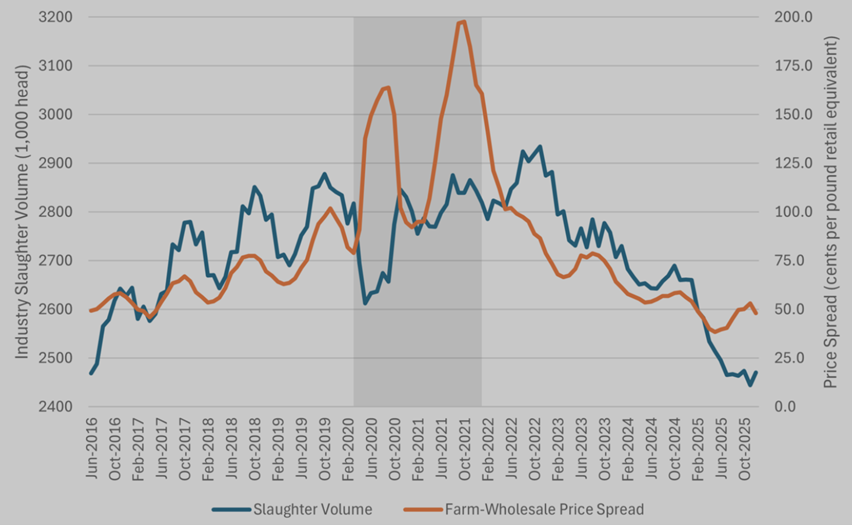
Figure 3 shows monthly cattle slaughter volumes and farm-to-wholesale beef price spreads between 2016–2025 and comes from Smith. The slaughter volume is shown by the blue line and the farm-wholesale price spread by the orange. The darker area in 2020-2021 is when COVID disrupted the packing industry and JBS suffered a cyberattack. Prior to 2020, as capacity and slaughter volume increased so did the price spread. During COVID, slaughter capacity was severely disrupted, but cattle supply and consumer demand remained unchanged, resulting in lower cattle prices and higher beef prices widening the spread dramatically. Since then, capacity and volumes slaughtered have shrunk along with the price spread as the model suggests.
Figure 3. Monthly Cattle Slaughter & Price Spread
Smith acknowledges the analysis is a simplified version of the real world and makes several assumptions, “While we know these assumptions don’t all hold in the real world, they allow us to focus squarely on how capacity constraints drive price spreads.” Smith’s work can be found at: https://agecon.unl.edu/capacity-constraints-and-beef-price-spreads/