Within Sight of $10 Billion


The latest projections peg Nebraska net farm income at $9.96 billion this year, $1.10 billion or 12% higher than projected income for 2025 and within sight of $10 billion. The projections come from the Rural and Farm Finance Policy Analysis Center at the University of Missouri in collaboration with the Center for Agricultural Profitability at the University of Nebraska.
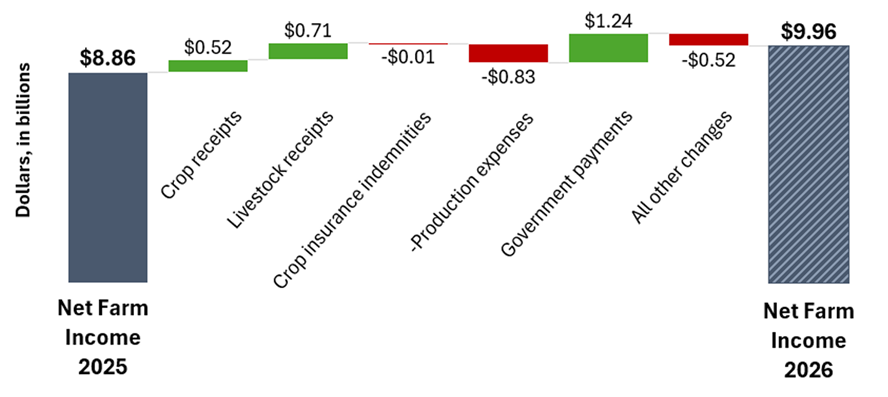
Figure 1 shows a “waterfall” chart outlining farm income components. Forecast income for 2025 is on the left and projected changes to various components this year are shown moving across the chart to the right culminating with projected income. Farm receipts are expected to increase $2.46 billion this year with expenses rising $0.83 billion. The growth in receipts is driven primarily by a $1.24 billion (71%) surge in government payments, expected to reach $2.97 billion, and increased livestock receipts. Both ad hoc assistance (bridge payments) and increased farm program payments contribute to the increase in government payments.
Livestock receipts are projected to be $0.71 billion higher, reaching a record $23.55 billion, driven by cattle receipts which are projected to increase $1.09 billion (5%) to $21.52 billion. The projections show crop receipts rising $.52 billion or 4%. Corn receipts are forecast to rise 5% on slightly higher prices and more sales due to last year’s large crop. Soybean receipts are expected to rise 4%. Expenses are projected to hit a record $30.37 billion, fueled by increases for purchased livestock, fertilizer, and fuel. Feed costs are projected to remain steady.
Figure 1. Changes in Nebraska Net Farm Income
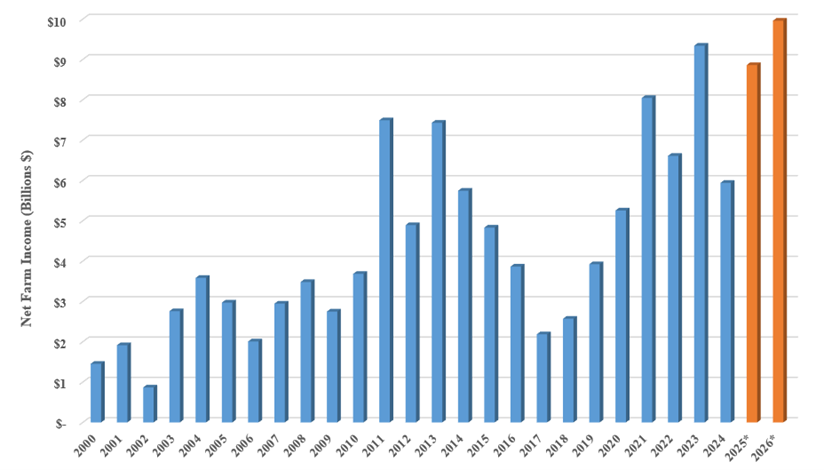
Projected farm income, if realized, would be the highest on record in non-inflation adjusted dollars (Figure 2). Still, Brad Lubben, agriculture policy specialist at the University of Nebraska says, “many producers may still be working with tight margins, even in a year when the aggregate income number looks very strong.” Projecting the future, never an easy task, is even more fraught in highly uncertain times like this year. Indexes continue to show historically elevated levels of uncertainty in today’s economy. Tariffs, trade deals, interest rates, input costs, international conflicts, government assistance, and other factors will affect future farm economic outcomes. Nevertheless, the latest projections provide insights into key factors affecting income for Nebraska agriculture, but much of the story is yet to be written. More information can be found at: https://cap.unl.edu/farm-income/. A webinar on the projections will be at noon CT on May 7. Register at https://unl.zoom.us/webinar/register/WN_B88ozl8ESfSCD_KExq-fjg#/registration.
Figure 2. Nebraska Nominal Net Farm Income (2000-2026)