Baumol's Cost Disease


William Baumol was an economist at New York and Princeton Universities. He wrote extensively on labor markets and authored hundreds of journal articles and more than 80 books. Baumol is best known for his “cost effect” or “Baumol’s cost disease” theory in labor markets developed with fellow economist William Bowen. In short, the theory says that rising wages due to labor productivity gains will create upward salary pressure in jobs that haven’t experienced productivity gains. The theory explains why salaries for people employed in people-dependent professions — i.e. education, health care, or arts — rise even though productivity doesn’t.
Baumol used an example of a string quartet to make his argument. A string quartet composed in the 1700s still requires the same number of musicians and same amount of time to play. Yet musicians today earn more than those in the 1700s did. Baumol argued that wages for musicians had to rise to keep them from forgoing a career in music and taking better-paying jobs elsewhere. The same thought applies to education or health care. There are limits to the number of students one teacher can teach or the number of patients health care professionals can see. In other words, productivity gains are sluggish in these sectors. But in order to keep people in teaching and health care professions, salaries need to remain competitive with other sectors.
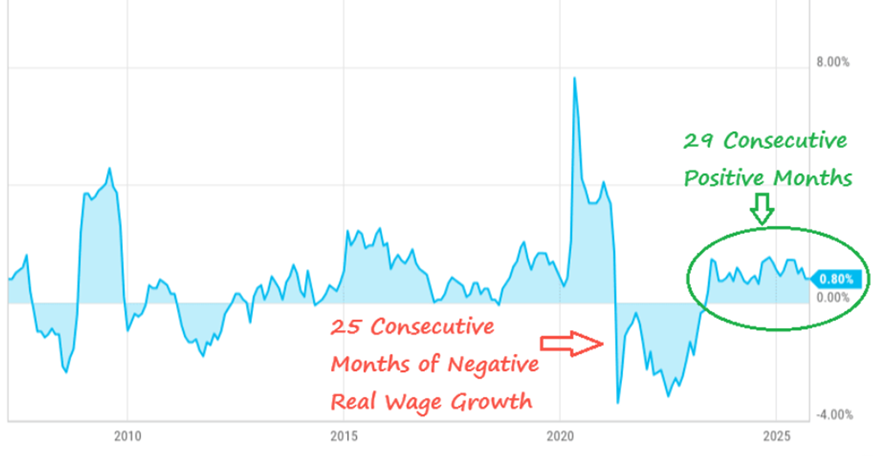
The theory explains in part why controlling local government spending and property taxes is difficult. The Legislature’s Fiscal Office reported that in school year 2016-17, the latest school year in which aggregated data is available, salaries and benefits for personnel accounted for 76% of schools’ general fund disbursements. The share is probably equally high for other local government entities. Inflation-adjusted wages in the U.S. have been rising. According to Charlie Bilello, as of late last year, wage growth outpaced inflation on a year-over-year basis for 29 months. And history shows growth in real wages is more common than negative wage growth (Figure 3). Thus, to retain public employees, local governments must keep salaries competitive. This, in turn, results in higher spending and taxes. A failure to keep up could result in personnel shortages. It’s an issue which has flummoxed elected leaders for decades.
Figure 3. U.S. Real Average Hourly Earnings (Year-over-Year % Change)