

Just Do It

Most people will remember NIKE’s famous slogan, “Just Do It.” Dr. Brad Lubben, farm policy specialist with the University of Nebraska, says the slogan applies well to the new base acre provisions in the One Big Beautiful Bill Act (OBBBA) passed last year. The provision allows producers to increase base acres under the farm programs. According to rules published by the USDA Farm Service Agency, the additional acres will be automatically allocated to eligible farms unless the owner requests not to receive additional base acres. Lubben says producers shouldn’t question whether to do it, “just do it.”
Base acres are the basis for payments under the Agriculture Risk Coverage (ARC) and Price Loss Coverage (PLC) programs. They are based on historical plantings and do not change year-to-year. Thus, farms’ base acres can differ significantly from current plantings. To be eligible for the base acre increase, OBBBA requires farmers to have planted eligible crops between 2019-2023 and show that plantings and prevented plantings of covered and eligible non-covered crops plus unassigned cotton base acres exceed base acres. OBBBA put a limit on the additional base acres at 30 million acres nationwide. If eligible acres exceed that amount, they will be prorated.
An analysis last July by Jessica Grosskopf and Cory Walters, agricultural economists with the Department of Agricultural Economics at the University of Nebraska, compared total acres of cropland in Nebraska from the 2022 Census of Agriculture to base acres. They found base acres make up approximately 75% of total cropland—15.9 million acres compared to 21 million acres. One reason for the difference is base acres only apply to covered commodities under the farm programs, for example corn, soybeans, sorghum, and wheat. Other crops like sugar beets, dry beans, or potatoes do not count towards base acres. Figure 1, from Grosskopf and Walters, maps base acres as a percentage of total cropland acres by county. The percentages vary considerably from 0% in Grant and Hooker Counties (no base acres) to 149% in Nance County (base acres exceed cropland acres). Counties with lower percentages could be ones which would benefit most from additional base acres.
The number and dispersion of new base acres will depend on decisions made by USDA during implementation. Agricultural economists at Ohio State University and the University of Illinois estimated Nebraska could be one of the biggest beneficiaries with a potential increase of 2.3 million base acres, third highest among states. Additional base acres will mean additional farm program payments. A key question for Nebraska is which crops will be included as eligible non-covered crops. If sugar beets, dry beans, dry peas, potatoes and other crops are included, counties where these crops are raised could see a significant boost in acres and payments.
Figure 1. Percentage of 2024 Base Acres to 2022 Cropland Acres by County
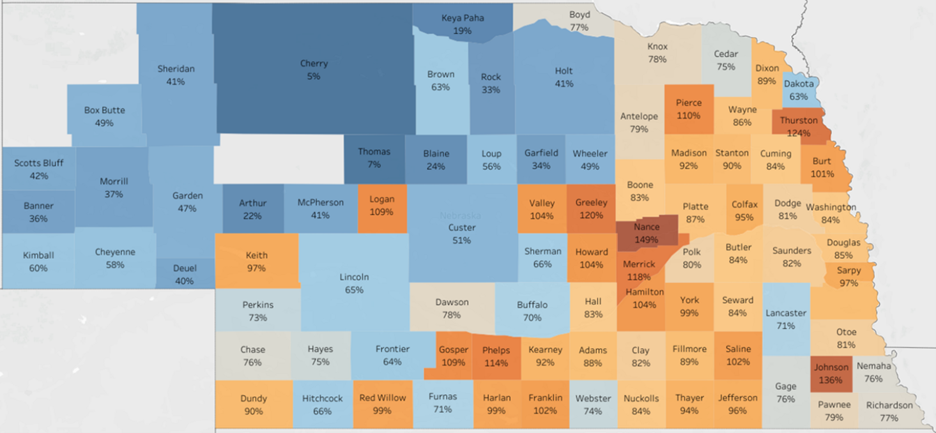
Source: Jessica Groskopf & Cory Walters, Cropland Acres vs Base Acres in Nebraska, Cornhusker Economics, UNL Dept. of Agricultural Economics, July 2025.