

Nebraska Property Taxes Are Growing Too Fast

Despite recent property tax relief efforts, Nebraska property taxes continue to rise at an unsustainable pace — far faster than income and inflation. Without action, this trend will continue to strain families, farmers, ranchers, and local communities across the state.
Since 2000, statewide property taxes have increased by 241%, while income growth has lagged far behind at just 106% during the same period. This growing imbalance highlights a system that is no longer aligned with taxpayers’ ability to pay.
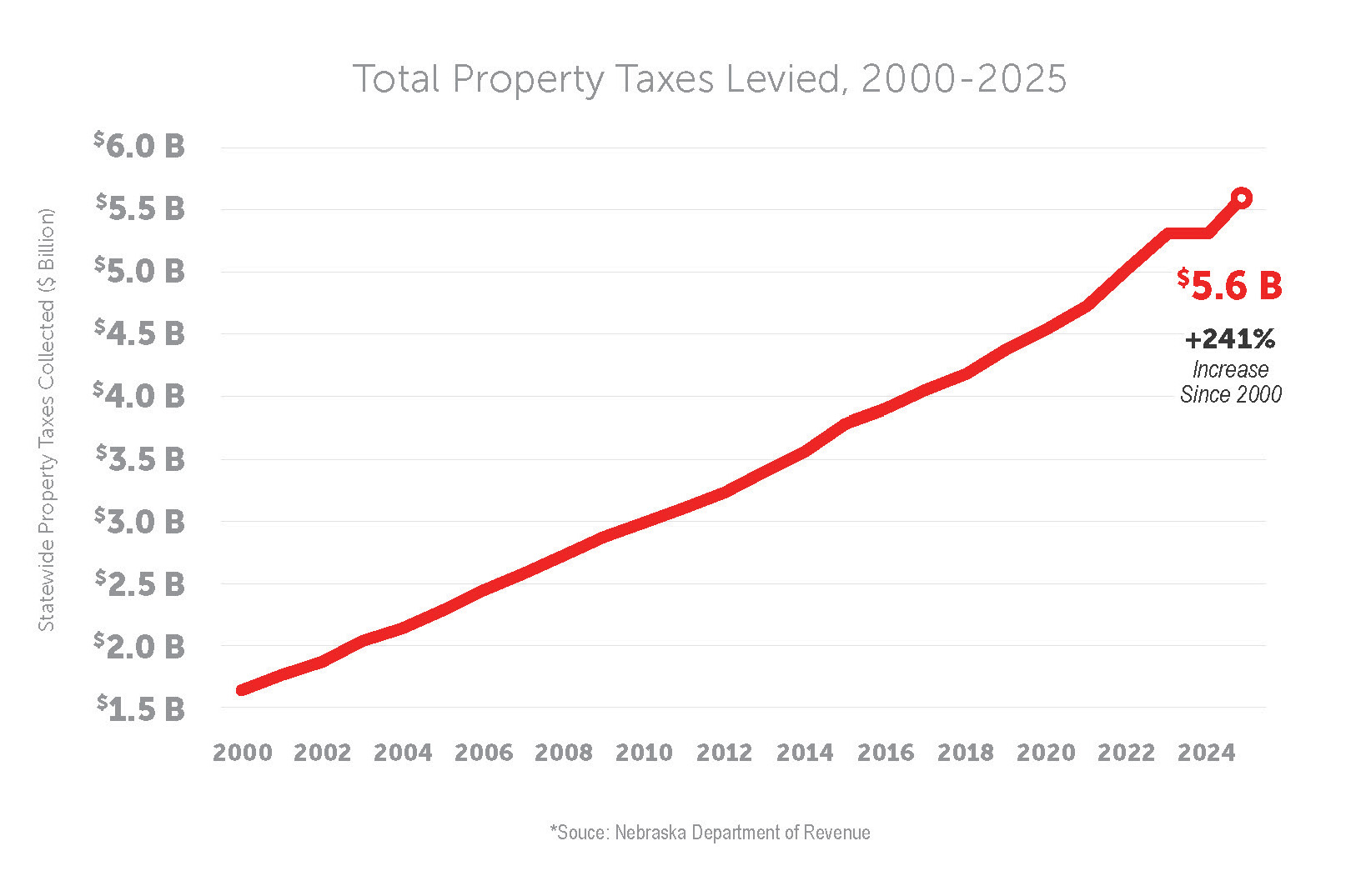
In just the past year alone, property taxes increased 5.39%, representing a $286 million hike statewide. That single-year increase erased much of the property tax relief achieved in 2024, when the state assumed most community college funding costs.
Every 1% increase in property taxes equals roughly $53 million statewide, and growth continues even after state relief efforts. For many families and agricultural producers, these increases are no longer sustainable.
Legislation introduced during the 2026 session — LB1219 and LR317CA — would place a reasonable limit on annual property tax growth. The proposal caps growth at 2% plus real growth, allowing communities to continue developing while preventing runaway tax increases.
This approach is not about cutting essential services. It is about restoring balance and predictability for both taxpayers and political subdivisions.
Under current trends, statewide property taxes are projected to grow at approximately 4% annually, based on a 10-year average. If that pace continues, property tax collections are estimated to reach $8.27 billion by 2035.
By comparison, a 2% cap on annual growth would keep collections closer to $6.8 billion in 2035 — a difference of $1.5 billion in taxpayer savings over time.

The graph shows property tax increases modeled for the next 10 years. This was used comparing a four percent increase and a two percent increase. The four percent comes from using 2015 to 2025 property tax data to find the ten-year-average change in property taxes levied equaling four percent. Then increasing property taxes levied by four percent and two percent annually until 2035. Without a cap property taxes are set to grow to at least $8.27 billion, but with a gap they are set to grow to $6.8 billion. The graph shows a large gap between these two routes. A $1.5 billion dollar gap. That is a gap that falls on homeowners and landowners in Nebraska.
See Real Property Value Change by county here.
Data also shows that property tax growth varies across local subdivisions — including counties, cities, school districts, natural resource districts, and fire districts — but the overall trend remains upward. Without a reasonable limit, total local property taxes continue to rise beyond what families and producers can reasonably absorb.
See History of Valuation and Taxes Levied by Political Subdivision 2015-2015 here.

Nebraska Farm Bureau supports thoughtful action to slow the growth of property taxes while preserving local control and essential services. A modest cap on annual growth provides a workable solution that benefits both taxpayers and political subdivisions.
Now is the time for the Legislature to act and put Nebraska on a more sustainable path for property taxation.