Shifting Receipts


The relative importance of different sources of receipts to Nebraska agricultural revenue has shifted markedly in recent years. As recently as 2020, cattle receipts ($9.6 billion) and combined receipts from corn and soybeans ($9.4 billion) were basically equal. In 2025, projected cattle receipts far outweigh those projected for corn and soybeans, $20.85 billion versus $10.3 billion (Figure 1). In effect, cattle receipts equated to $2.00 for every $1.00 of corn and soybean receipts. The 2025 figures come from income projections reported last October by the University of Nebraska Center for Agricultural Profitability in cooperation in the University of Missouri Rural and Farm Finance Policy Analysis Center.
Figure 1. Nebraska Agricultural Receipts (2010-2025F)
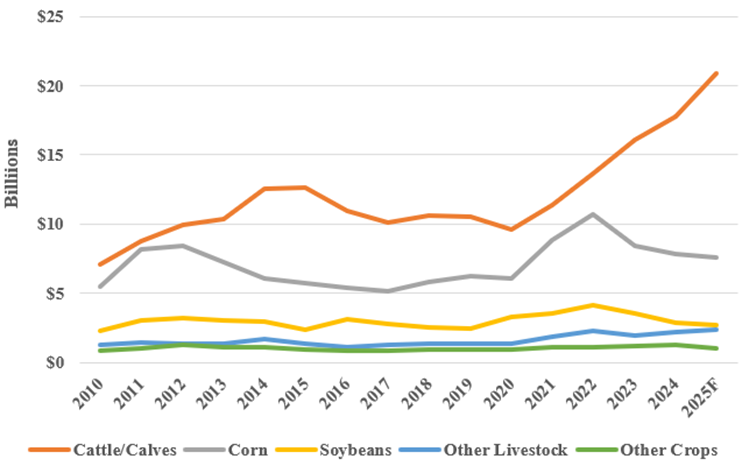
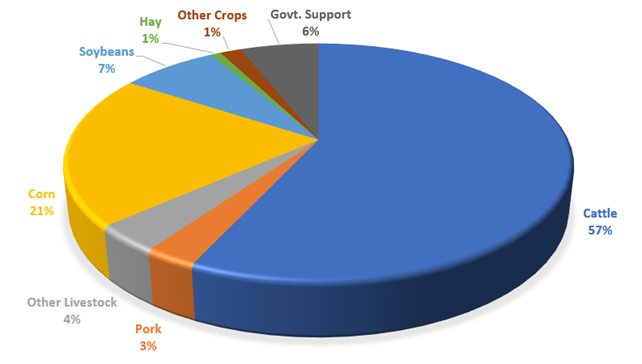
Figure 2 breaks down the relative importance of different commodity receipts for 2025. Estimated direct federal government payments are included. Government payments are projected to equal 6% of last year’s revenue streams. Cattle receipts are projected to account for 57% of revenue streams, the highest share in 16 years, growing rapidly from 40% in 2020. Cattle receipts as a share of total revenue ranged from 38%-55% since 2010.
Two things stand out regarding the shift in the relative importance of receipts. First, cattle’s growing share is due entirely to surging cattle receipts and not shrinking crop receipts. In fact, corn and soybean receipts are projected to be higher in 2025 compared to 2020 by almost 10%. Nevil Speer, a cattle industry consultant, calculated that the growth in revenue from sales of fed cattle averaged a phenomenal 15.8% since 2020. Such a rate is further evidence of the uniqueness of current cattle market conditions.
Second, the shift shows how the diversity between livestock and crop sectors in Nebraska helps stabilize the agricultural economy. While the crop sector is presently struggling to generate positive returns, the cattle sector has more than pulled its weight to offset it. This means a more stable and less volatile Nebraska agricultural economy.
Figure 2. Projected Receipts for 2025