

Supply, Demand, & Prices

The primary factors for Nebraska agriculture’s fortunes will be the market fundamentals in corn, soybeans, and cattle markets. Combined, the three commodities account for roughly 90% of the state’s agricultural receipts.
Tight cattle supplies and strong consumer demand for beef will continue to drive cattle markets in 2026. Nebraska auction barns reported sales of 500-600 lb. feeder steers in late December at $480 per cwt. compared to $354 a year ago, a 58% increase (Table 1). Sales of live steers in late December averaged nearly $230 per cwt. compared to $196 per cwt., a 17% rise. Fewer cows and calves—Oklahoma State University Derrell Peel says the U.S. calf crop in 2026 was the lowest since 1941—combined with the ban on cattle imports from Mexico mean fewer cattle will be available for placement in feedlots this year. This, in turn, means fewer cattle available for slaughter. Thus, cattle and beef supply challenges coupled with continued strong consumer demand should result in cattle prices continuing their record-setting climb higher. Peel expects both feeder and live cattle prices to increase between 5-15% this year. Profitability in the sector is expected to continue this year.
Table 1. Nebraska Feeder & Live Cattle Prices

A lingering question for the sector is when herd expansion might begin in earnest. Currently, there is little evidence that beef heifer retention is occurring to any great degree. A livestock economist at the University of Arkansas attributes the lack of retention to “structural constraints, input costs, and financial considerations.” He also says these factors “will likely delay a rapid recovery in beef cow numbers.” Market observers will be watching closely this year for signs the corner may have turned. Another question is whether the short cattle supplies will result in more facility closings. Tyson’s shutdown of its Lexington facility demonstrates higher cattle prices and tight cattle supplies can come with a cost.
One risk for the sector is whether consumer demand for beef will wane. Consumers have shown a remarkable determination to maintain beef purchases despite higher prices. However, concerns over affordability, general consumer malaise, and a slowing economy could chip away at demand. A slowing demand could filter down and weigh on cattle prices.
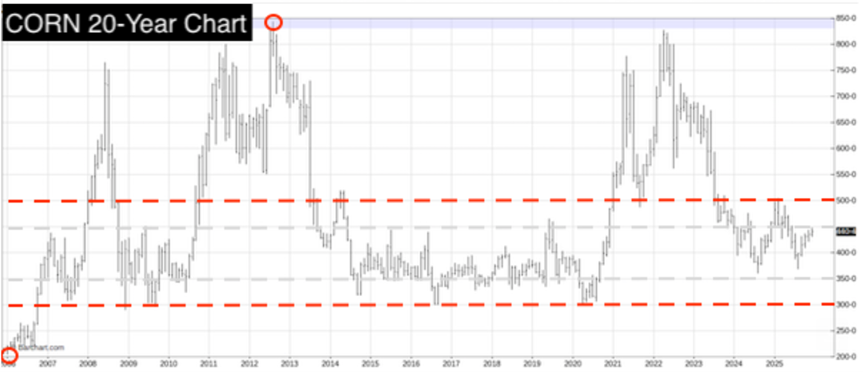
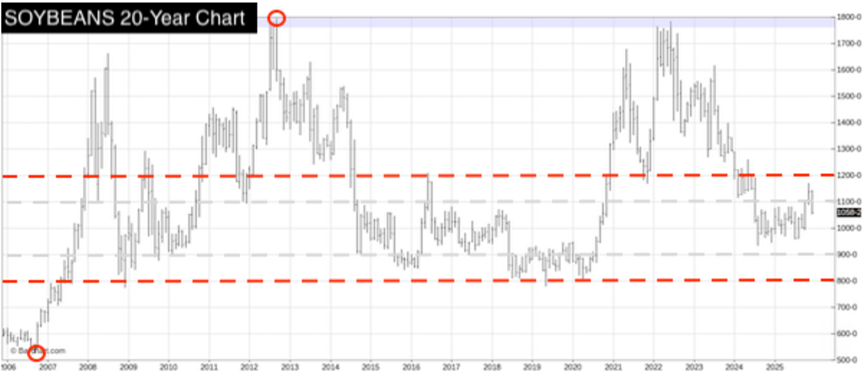
Corn and soybean prices continue to languish at low levels. Nebraska cash bids for corn are around $3.97 per bushel this year compared to $4.25 last year. Bids for soybeans are $9.45 per bushel, roughly $0.30-$0.50 higher than last year. Figure 2, from The Van Trump Report, shows the 20-year price history for corn and soybeans. Since mid-2023, prices have declined, reaching levels similar to those that existed during the previous downturn in 2014-2021. At that time prices remained entrenched at low levels for almost six years until Chinese purchases in 2020 provided the impetus for a breakout higher.
Figure 2: 20-Year History of Corn & Soybean Futures Prices
Will a breakout occur in 2026? Current price forecasts offer slim hope. The USDA projects the season-average corn price will be $4.00 per bushel this marketing year and an average soybean price of $10.50 per bushel. The projected corn price is $0.24 lower than last year. The soybean price is $0.50 higher, improved but not a breakout. Futures markets don’t suggest higher prices either. The good news is most market observers do not foresee prices falling much below current levels. The bad news is that they don’t see them moving higher either. Thus, low prices combined with higher costs mean 2026 will be another struggle for crop producers.